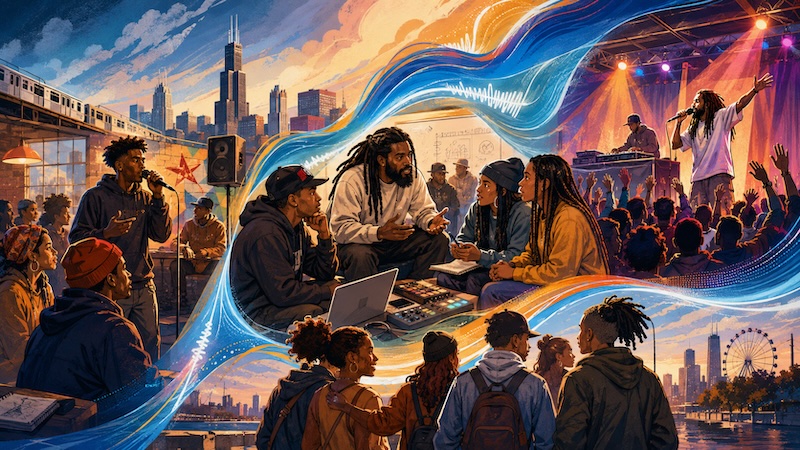
About 100 ninth graders entered the Bronx School of Hip Hop in September as its founding class. A live DJ welcomed students on the first day. In one geometry class, students used a microphone to rap through mathematical work. These scenes drew attention because they took place inside a traditional New York City public high school, not an arts elective, a charter program, or an after-school workshop.
The new school, located at 1600 Webster Avenue in Claremont, asks New York to support a larger claim. If the city identifies itself as the birthplace of Hip Hop, it must invest in the people, knowledge, and institutions that sustain the culture in the communities where it began. The school is one part of that public responsibility. Its value will depend on rigorous academics, stable funding, trained teachers, fair ownership rules, credible career pathways, and public evidence about student experience and learning.
From Birthplace to Home
Mayor Zohran Mamdani stated the larger issue during a September 30 conversation with Nas about the past, present, and future of Hip Hop in New York.
“We can’t be content with New York City simply being the birthplace of Hip Hop. We want it to still be its home, and that means ensuring that the artists who create here are actually able to live here.”
Mayor Zohran Mamdani
The statement raises a citywide policy question about cultural survival. A public high school does not make rent affordable, protect artists from displacement, or guarantee sustainable creative work. Mamdani’s quote does not prove the school addresses those problems. It defines a goal against which the city’s wider commitment should be judged. Housing, arts funding, production space, youth employment, access to capital, and legal education all affect whether artists remain in New York.
The Bronx School of Hip Hop offers a specific form of investment: free public education organized around the culture as knowledge, method, and business. New York has often honored Hip Hop through anniversaries, public events, and institutions devoted to its history. The school also arrives as the Bronx expands its institutional investment in Hip Hop: The Hip Hop Museum at Bronx Point, a 52,000-square-foot cultural and archival institution, is scheduled to open in fall 2026 just a few miles from where the culture began. A school has a different obligation because students and families depend on it every day for academic preparation and future options.
A New Public School With a Measured Start
The Bronx School of Hip Hop opened with grade nine and plans to add one grade each year until it serves grades nine through twelve. Reports from the opening put the founding class at about 100 students. State registration documents had projected 125 students in the first year and 500 at full growth. Those figures describe separate things: about 100 is the reported opening enrollment, while 125 and 500 are planning projections.
NYC officials describe the school as the nation’s first traditional, non-charter public high school dedicated to Hip Hop. That wording needs to remain precise. The High School for Recording Arts in St. Paul, Minnesota, has long offered a charter-school model centered on music business, creative work, and project-based learning. The Bronx school is distinct because it places a Hip Hop-centered model inside New York City’s conventional public-school system.
It also does not occupy a stand-alone campus. The school shares Building X147 with I.S. 339 and P.S. X469, the Bronx School for Continuous Learners. Co-location makes equitable resource distribution a public obligation. Studio access, dance space, technology, libraries, cafeterias, accessibility, and student services must be managed across schools. The new program’s profile should not result in unequal treatment for students already in the building.
Teaching the Five Elements and the Core Subjects
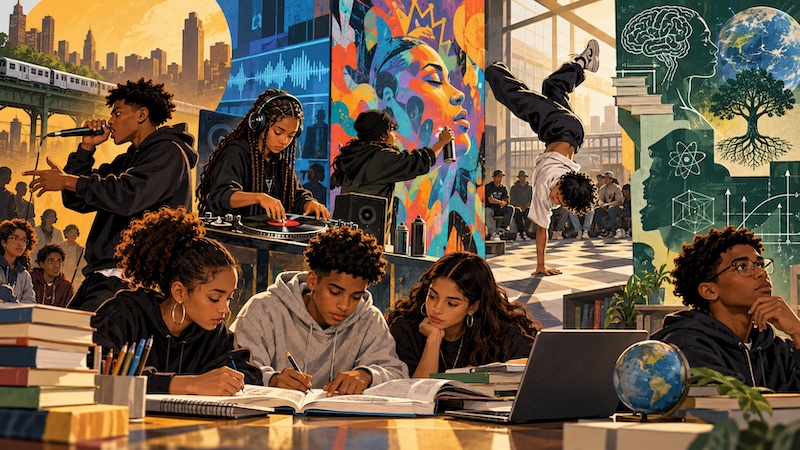
The curriculum centers emceeing, DJing, graffiti, breaking, and knowledge of self. Students are still expected to complete the academic work required of a New York City public high school. MySchools describes a Regents- and AP-aligned core, project-based learning, public exhibitions, and a Hip Hop Enterprise Lab focused on entrepreneurship, financial literacy, and brand development.
Early examples include using emceeing to study rhetoric and persuasive writing, pairing artists such as Nas, Rakim, and Kendrick Lamar with established literary texts, and using beat production or DJing to teach ratios and analysis. The goal is to connect academic content with forms students recognize while requiring serious work in English, mathematics, science, social studies, and world language.
Christopher Emdin and Edmund Adjapong developed the idea for the school from years of work in Hip Hop education. Teachers College identifies reality pedagogy as its central teaching philosophy. The approach treats students’ cultural knowledge and lived experience as academic resources. Emdin helped prepare the first teacher cohort, while founding principal Jason Reyes is responsible for turning the concept into daily instruction.
Implementation will matter more than branding. Teachers need subject expertise, cultural knowledge, planning time, equipment, and sustained coaching. Students who do not want to rap, dance, draw, or perform in public need equal ways to demonstrate mastery. Young people must also have room to question an adult-defined Hip Hop canon and bring their own tastes, identities, and criticism into class.
Ownership Needs Rules, Not Slogans
The school’s business focus gives it relevance beyond performance. Its published plans include Adobe Creative Suite, audio production, and digital media certifications, along with financial literacy and brand development. Teachers College and city materials also describe future internships, college opportunities, and creative career paths.
Those are planned opportunities, not completed results. Public reporting has not supplied a full list of signed internship partners, guaranteed placements, pay terms, transportation support, or college agreements. The same caution applies to certifications. Families need to know who issues each credential, when students become eligible, and whether colleges or employers recognize it.
Ownership education requires similar detail. If students make beats, recordings, videos, designs, podcasts, or business proposals with school equipment, written policies should state who owns the work. Students need instruction in publishing splits, sampling, licensing, royalties, contracts, trademarks, releases, and digital distribution. They also need meaningful consent when the school, city, a partner, or a researcher wants to use their work for promotion.
The school has received a $350,000 Fiscal Year 2027 capital equipment allocation from Bronx Borough President Vanessa Gibson for items including cameras, laptops, tablets, microscopes, and mobile media carts. That money is an equipment allocation, not the school’s total budget. As enrollment grows, the city should disclose the operating, staffing, facilities, and program funding required to deliver the model.
Evidence, Evaluation, and Student Power
Research provides reasons to take Hip Hop-based teaching seriously, along with reasons to evaluate it with care. A 2024 systematic review of 68 peer-reviewed articles identified support for culturally relevant learning, participation, and critical thinking. A separate review of 15 studies reported themes including motivation, engagement, expression, and interaction.
The evidence does not establish a broad causal link between a Hip Hop theme and higher test scores, graduation rates, or long-term earnings. Many studies are qualitative, small, observational, or based on programs that differ in length and design. Researchers also warn about tokenism, stereotypes, unclear definitions, and teaching that uses Hip Hop as an attention device without engaging its history or social analysis.
The Bronx school will serve as a research site connected to Teachers College and the Edmund W. Gordon Institute for Advanced Study. That role creates a chance to document the model, along with duties involving family consent, student assent, privacy, data ownership, and independent evaluation. Researchers connected to the school’s founders should not be the only people assessing its results.
The first public measures should include attendance, credit accumulation, Regents performance, disciplinary equity, teacher retention, credential completion, paid placements, postsecondary transitions, student belonging, and family trust. Reporting should also show who receives opportunities across gender, disability, language status, and income. Students and families need formal influence over curriculum, research, rights policies, and resource decisions.
Opening the Bronx School of Hip Hop is historically significant, but that status does not demonstrate student outcomes. If New York wants Hip Hop to remain at home, the city must support the school after public attention shifts elsewhere and publish honest evidence about where it succeeds or falls short. The institution should be judged by what students learn, what rights they retain, and what choices they gain.





2 thoughts on “The Bronx School of Hip Hop Launches”