
How GoodWaves Could Rebuild Hip Hop’s Missing Middle
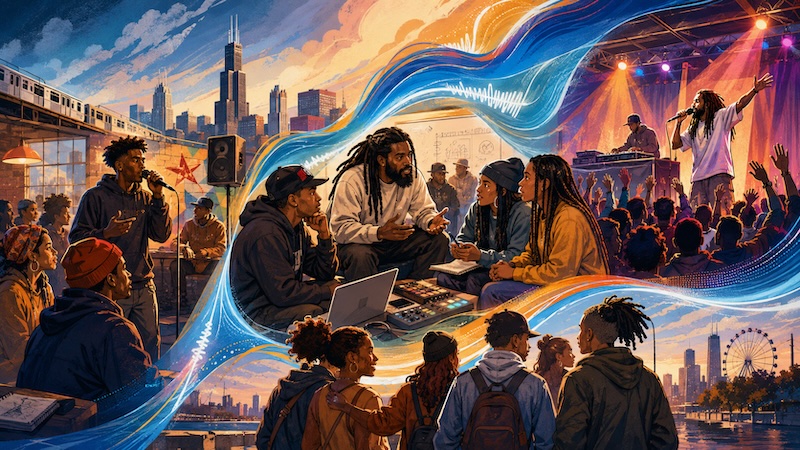
Hip Hop does not lack for big stages. What it lacks, in many cities, is a stable middle layer where emerging artists can learn the business, build peer networks, test their work in public, and get useful access without paying for a badge or buying into a showcase system. That gap is not an accident. It is the predictable result of how most of the industry’s development pipelines are funded: ticket revenue that eventually runs dry, application fees that price artists out before they’re even heard, or brand-owned programs that pick a handful of winners and move on. GoodWaves is worth paying attention to precisely because its public model looks like an attempt to avoid all three failure modes at once.
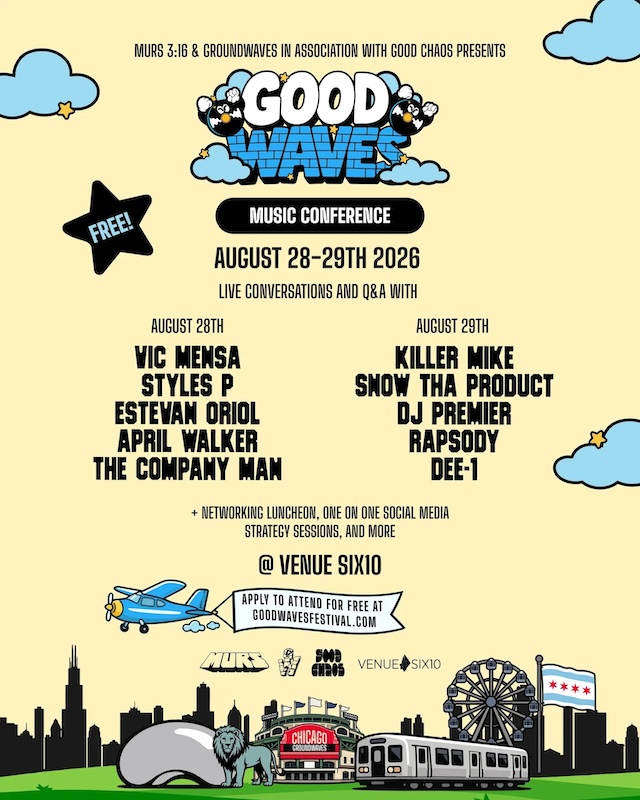
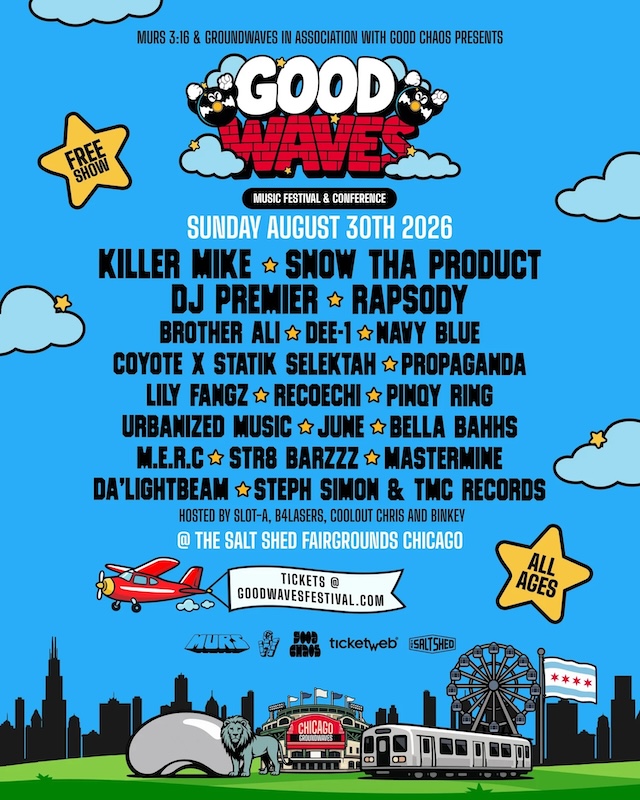
When Groundwaves announced its first GoodWaves Music Festival & Conference on July 13 for August 28-30 in Chicago, the public pitch was not just about a lineup. It was about artist development. PR Newswire says the event is presented by MURS 3:16 and Groundwaves in association with Good Chaos, with conference programming at Venue Six10 on August 28 and 29 and a free, all-ages festival at The Salt Shed Fairgrounds on August 30. TicketWeb confirms that the festival is free, tickets are required, and entry is first come first served subject to venue capacity. The Source repeats the structure and frames the weekend as a blend of artist development, education, and live music. Read against how the rest of the industry usually handles this, that combination, free and structured, is not a small thing.
The Case Against Pay-to-Play, in Real Numbers
To understand why GoodWaves’ free model is important, it helps to see what artists are usually asked to pay, in money or in labor, for the kind of access GoodWaves is offering for nothing.
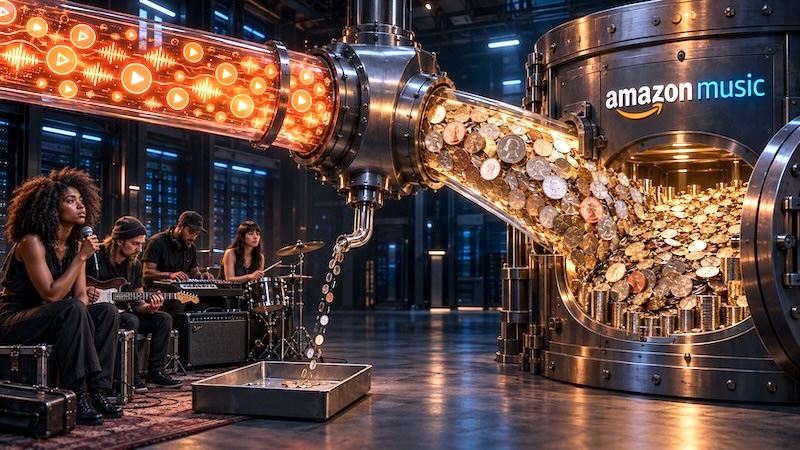
Independent Hip Hop’s pay-to-play circuit runs on cost-shifting. A single venue night commonly costs somewhere between $2,000 and $5,000 to produce, and many promoters pass that cost directly to performing artists, either through flat fees for a slot or a requirement to sell a set number of tickets. The showcase-festival circuit runs on a related logic: the application fee. At SXSW, artists pay to apply, with early-entry fees around $35 rising to $75 as deadlines approach, and only selected artists are compensated after that, at rates of roughly $150 to $400, or a credential package instead of cash. Advocacy groups like the United Musicians and Allied Workers have argued publicly that even after recent increases, that compensation falls below the value of the credential artists are asked to accept, and below the cost of a single festival badge. Canadian Music Week charges a comparable application fee in exchange for conference access that would otherwise run several hundred dollars.
Set against that, GoodWaves’ structure is a genuine departure: no application fee, no ticket-selling requirement, and both the conference and festival free to attend. That is the actual innovation in the “free” framing. It isn’t just marketing language for a no-cost ticket. It removes the two most common financial gatekeepers, the paid application and the cost-shifted slot, that keep emerging artists out of these rooms in the first place.
Learning From Paid Dues
This is not MURS’s first attempt at building independent infrastructure, and that history is part of why GoodWaves’ funding model looks like a real evolution rather than a fresh gamble. In 2006, MURS co-founded Paid Dues, an independent Hip Hop festival that ran in Southern California and, in some years, toured to other cities, showcasing acts like Aesop Rock, Little Brother, and De La Soul before later years brought in Kendrick Lamar and Black Hippy ahead of their mainstream breakthroughs. Paid Dues proved that an artist-led, non-major-label festival could draw a real audience and book credible talent for the better part of a decade. It also ran on ticket revenue, and public accounts describe MURS operating it at a financial edge to keep it going, before it stopped running after its 2013 edition for financial reasons.
GoodWaves appears to have learned directly from that. Instead of asking attendees and artists to fund the event through ticket sales, the way Paid Dues did until the model became unsustainable, GoodWaves is funded through a named community partner in Good Chaos, with the free-to-attend structure covering both artists and the public. MURS has described GoodWaves as the realization of a long-held vision, which reads less like a rebrand of Paid Dues and more like a second attempt at the same mission with a funding model built to survive longer. It’s a fair thing to flag that sponsor-backed funding carries its own risk, since it depends on continued institutional interest rather than box office, and the public record doesn’t yet show a long-term plan for what happens if that interest changes. But swapping one kind of fragility for a different one, after watching the first kind sink the previous project, is itself a reasonable bet.
What Good Chaos’ Backing Actually Looks Like
The strength of that bet depends on what kind of partner Good Chaos is, and the public record here is more encouraging than a typical sponsor credit. Good Chaos’ own site describes itself as a Chicago-based studio that invests in community spaces, artists, creative visionaries, sustained movements, and paths to expand economic opportunity. That framing puts the partnership closer to community investment than brand placement.
It’s worth naming the alternative model this isn’t, because the contrast is instructive. Brand-funded artist-development programs like Red Bull Music Academy have historically worked as invitation-only pipelines: a small, centrally selected cohort, embedded in facilities the sponsor built, with continued support afterward tied to the brand’s own promotional channels. That model gets a small number of artists real resources, but it exists to build the sponsor’s cultural credibility as much as the artists’ careers. GoodWaves’ public structure, a 400-person open application with no product to sell, looks like a bet on the opposite trade: wider access over a tighter, brand-controlled relationship.
That reading is backed up by more than the mission-statement language. A Partiful listing for Groundwaves Generations, a free recurring Chicago event unconnected to the August festival, confirms it too is free, includes food, and is supported by Good Chaos. A National Public Housing Museum listing for a 2026 installment of the same series shows the same backing around family-oriented programming that has no obvious marketing payoff for a sponsor. Good Chaos is not just attached to the marquee weekend. It’s underwriting the smaller, less visible events that build the audience the festival depends on. Public materials still don’t disclose a full budget or fee structure, and that’s a fair thing to want published. But the pattern of where the money shows up is a stronger signal than a launch-day sponsor credit would be on its own.
A model that had only ever worked in one small market would be a much bigger gamble scaling up; a model that has already proven portable across Fort Collins, Denver, Tulsa, and Northwest Arkansas has a real basis for confidence that it can hold its shape in a bigger city too…
The Mentorship Case Has a Track Record
The artist-development claim is also not new marketing language invented for Chicago. Groundwaves has been running a version of this model since 2019, when it launched in Fort Collins, Colorado in partnership with the Music District and the Bohemian Foundation, and has since operated in Denver, Tulsa, and Northwest Arkansas. In each city, the format has centered on the same idea: an open mic followed by real one-on-one time with MURS. Local reporting from Colorado and Arkansas describes artists signing up for mentorship sessions the day after performing, MURS holding 45-minute individual meetings, and an ongoing monthly cadence where artists could ask about touring, publishing, and next steps. In Colorado, that relationship produced a tangible artifact: a compilation album built from years of feedback with a group of mentees. In Arkansas, the program’s manager was himself a past participant, which is about as concrete a sign of durable impact as an open, unverified program can offer.
That is a genuine five-year record across four regions, and it means Chicago is not a debut, it’s the largest expansion yet of something that has already worked in smaller markets. The one honest caveat worth keeping: GoodWaves’ Chicago conference is publicly described as on-stage one-on-one conversations and group workshops, a more public format than the smaller, recurring sessions documented in the earlier cities. Whether that same individualized mentorship model carries over at Chicago’s scale isn’t confirmed in public materials yet. But the underlying claim, that MURS and Groundwaves have a real history of hands-on artist development rather than just stage time, is well supported by everything outside Chicago.
A Bigger Room, With a Real Shot at Staying Grounded
Scaling to Chicago, and pairing that scale with major names like Killer Mike, DJ Premier, and Rapsody, is the biggest test the model has faced. It’s a fair question whether a larger market and a marquee bill risk pulling focus toward the headliners’ existing fanbases rather than local Chicago artists. But the same history that raises the question also offers a reason for confidence: Groundwaves has already had to adapt its format across four different regions and local partners without losing its core structure of an open, low-barrier entry point followed by direct access to MURS. That’s not nothing. A model that had only ever worked in one small market would be a much bigger gamble scaling up; a model that has already proven portable across Fort Collins, Denver, Tulsa, and Northwest Arkansas has a real basis for confidence that it can hold its shape in a bigger city too, even if the exact mix of famous names and emerging locals in Chicago is still an open question worth watching.
Why This Is Worth Rooting For
Put together, the public record makes a real case, not a proven one, but a real one, for why GoodWaves could be a positive vehicle. It removes the two financial gatekeepers, the application fee and the cost-shifted slot, that keep working artists out of these rooms elsewhere. It’s backed by a funder whose money shows up in the small, unglamorous events as much as the marquee weekend, which is a better signal of genuine investment than a sponsor logo. It’s built by someone who already tried the ticketed version of this idea, watched it become unsustainable, and came back with a structure designed to solve exactly that problem. And its mentorship claim isn’t a first-time promise; it’s the extension of a five-year pattern with named participants who can describe what they actually got out of it.
None of that is a guarantee. The selection process for the 400 conference spots isn’t public. The full budget isn’t public. And whether the Chicago conference’s on-stage format delivers the same individual mentorship the smaller cities got is still an open question. Those are worth watching as the weekend approaches and afterward. But the honest read of the public evidence is that GoodWaves has assembled the pieces, a free structure, a funder with a track record in the model, and an artist with a documented history of doing exactly this kind of work, that Hip Hop’s missing middle actually needs. That’s a meaningfully stronger starting position than most festivals claiming “artist development” ever bother to build.



One thought on “How GoodWaves Could Rebuild Hip Hop’s Missing Middle”