
Killer Mike’s Call to Action Rings Hollow
The Supreme Court of the United States issued a ruling that civil rights leaders called a direct attack on Black political power. The court voted 6 to 3 to gut key provisions of the Voting Rights Act of 1965. The Court did not formally erase Section 2 from the law, but it changed the standard in a way that makes future racial vote-dilution claims much harder to win. This landmark law had protected Black Americans from discriminatory voting practices for more than 60 years. In the majority opinion, Justice Samuel Alito wrote that the law was no longer needed because, quote, “vast social change has occurred throughout the country and particularly in the South.” The dissent came from Justice Elena Kagan, who wrote that the court was acting like a partisan legislature rather than an impartial judicial body. Civil rights leaders fired back immediately. Reverend Al Sharpton said the decision put “a bullet in the heart of the voting rights movement.” Congressman Bennie Thompson called it “Jim Crow 2.0.” Marc Morial of the National Urban League labeled it “a judicial coup.” Ambassador Andrew Young was even more blunt. He said the Supreme Court would, quote, “go to hell” for this decision.
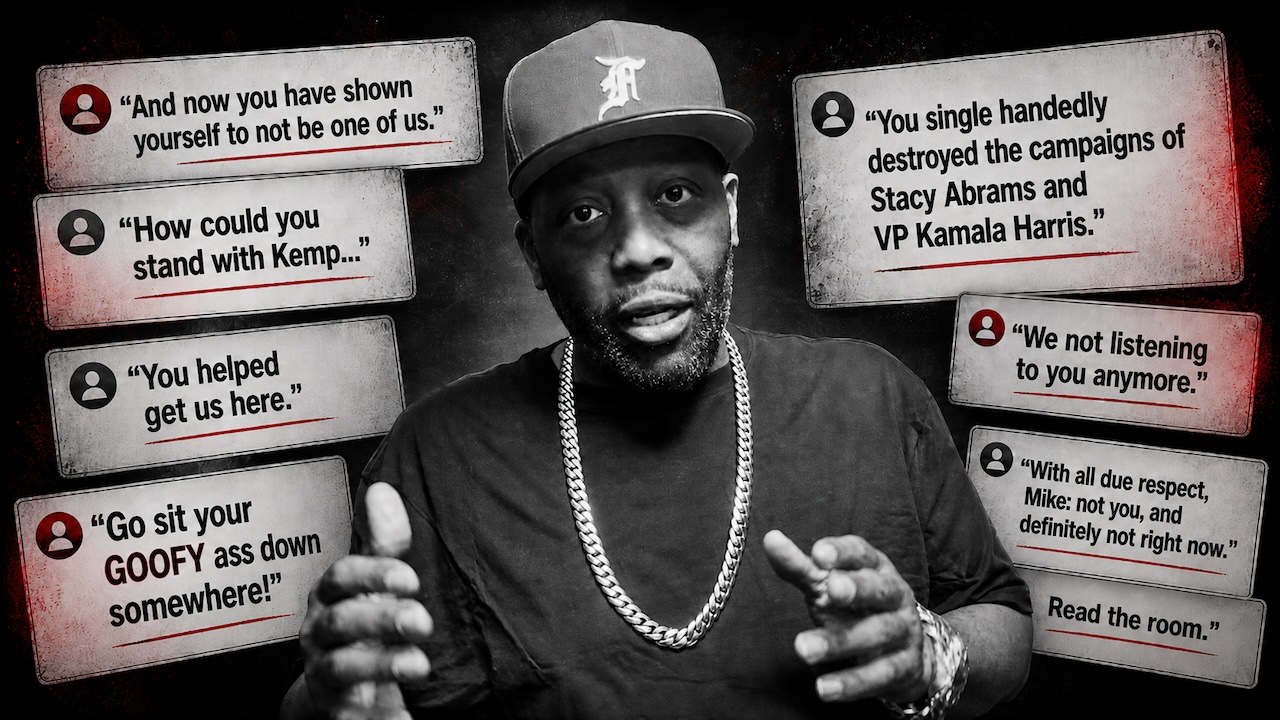
That same week, rapper and activist Killer Mike posted a message on social media that was meant to respond to this crisis. His message read: “Americans, we got work to do at and beyond the polls this year. No matter what, plot, plan, strategize, organize and mobilize!” On the surface, there is nothing controversial about telling people to vote. That is what the Voting Rights Act was designed to protect. But the internet has a long memory, and the backlash was immediate and fierce. Critics from across social media dragged Killer Mike for past statements and political moves that they say helped create the conditions for this very moment. The debate spread across Threads, X, Instagram, and hip hop news outlets.
But his critics are also right that his political moves over the past decade have sent deeply contradictory signals at the exact moments when clarity was most needed.
What Killer Mike Actually Said And Why It Sparked Outrage
Killer Mike, whose real name is Michael Render, posted his call to action in response to the Supreme Court ruling. He called on Americans to mobilize at the polls and beyond. He promoted his broader voting initiative that he has been building for months heading into the midterm elections. His message was clear and direct. Plot, plan, strategize, organize, and mobilize. Those are words that fit the activist tradition that Killer Mike has tried to build over his decades-long career. But critics were not having it. One post that got major traction read, “Killer Mike encouraged people not to vote and disparaged people from voting for Hillary, Kamala and Biden. I used to respect him but he is counterproductive and does not understand the state of today’s game of politics. His advice has set us back tremendously.”

That is the core of the criticism. The anger is not really about what Killer Mike said in that specific post. The anger is about everything he said before. People are looking at his political history and seeing patterns that they believe helped enable the Trump era and the rollback of voting rights that followed. Here is what critics are pointing to. In 2016, Bernie Sanders ran for president as a progressive candidate with strong support from young Black voters. Killer Mike became one of his most vocal supporters. He stump-speeched for Sanders at campaign events in South Carolina and across the South. When Sanders lost the nomination to Hillary Clinton, Killer Mike refused to support her. He publicly said Clinton was, quote, “bad for Black people.” He sat out the general election. Many of his followers likely did the same. In 2020, he declined to endorse Joe Biden or Kamala Harris. He stayed silent during some of the most consequential elections for Black Americans in decades.
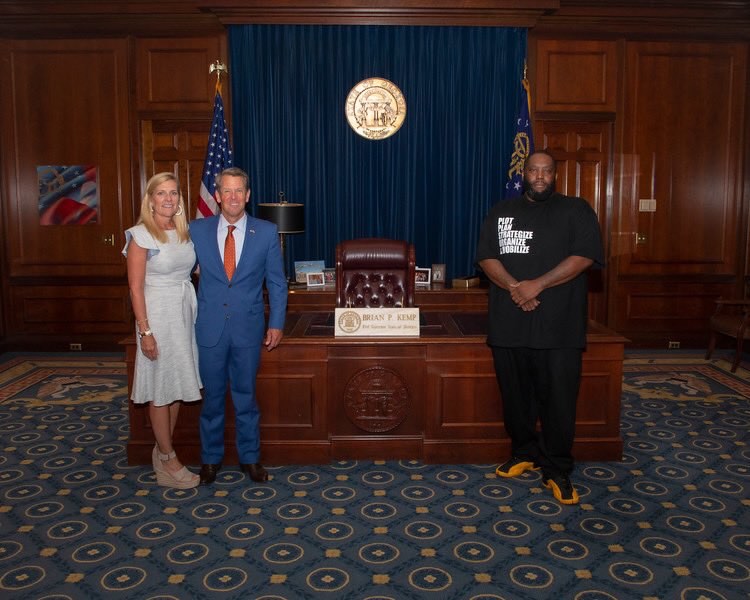
Then came 2022. In the Georgia Senate race, Killer Mike sat down for an interview with Herschel Walker, who was the Republican nominee. Walker had no political experience. He had a history of making racist, sexist, and violent statements. He was backed by Donald Trump. He was running against a Black Democratic senator, Raphael Warnock, who was the pastor at the same church where Martin Luther King Jr. once preached. Killer Mike gave Walker a platform and legitimized his campaign in the eyes of some Black voters. He also met with Georgia Governor Brian Kemp, who had signed one of the country’s most controversial post-2020 voting laws and had become a central target of voting-rights advocates. After that meeting, Killer Mike said Kemp was, quote, “running an effective campaign” and suggested that Stacey Abrams, the leading voting rights organizer in Georgia, should follow Kemp’s lead. Critics say these moves gave political cover to people who actively worked to suppress Black votes and to overturn the 2020 election results.
The Case Against Killer Mike Is Real But It Is Complicated
The criticisms of Killer Mike are not made up. They are documented. He did refuse to support Hillary Clinton in 2016. He did refuse to support Joe Biden and Kamala Harris in 2020. He did platform Herschel Walker and meet with Brian Kemp in 2022. These are facts. The question is whether these actions actually contributed to the political outcomes that critics claim. Did his non-endorsement of Clinton cost her votes in crucial states like Pennsylvania, Michigan, and Wisconsin? Did his silence on Biden and Harris help suppress the Black vote in 2020, a year when Black voter turnout actually hit historic highs? Did his Walker interview and Kemp meeting actually move Black voters toward Republican candidates in Georgia? These are harder to prove with certainty.
What we do know is that Black voter turnout dropped in 2016 compared to 2012. Hillary Clinton lost key swing states that Barack Obama had won. Some analysts have pointed to lower Black turnout as a factor in those losses. In Georgia specifically, the 2021 Senate runoff saw Raphael Warnock and Jon Ossoff win on the Democratic side. But it was razor close. Stacey Abrams had spent years building a voter registration and turnout operation that was credited with helping Democrats win in 2020 and 2021. Did Killer Mike’s association with Kemp send a confusing signal to Black voters about who was fighting for them? That is a legitimate question that critics are asking. The realistic effects of celebrity political endorsements and dis-endorsements are hard to measure precisely. But the critics are not simply making things up. They are connecting real dots.
Killer Mike’s defenders say he has done more good than harm. They point to his decades of community work in Atlanta, his support for Bernie Sanders as a genuine progressive candidate, his advocacy for criminal justice reform, and his consistent message about Black Americans taking political power into their own hands. They also argue that nobody should be expected to endorse every Democratic candidate just because that is what the party expects. Killer Mike has maintained that his independence is what gives his political voice credibility. The defenders also note that his current message is straightforward and positive. Vote. Organize. Mobilize. Those are things that no reasonable person should oppose. But the critics say this is exactly the problem. You cannot spend years legitimizing Republican voter suppression and then act like the guy showing up to tell people to vote when the damage is already done. That is like lighting the house on fire and then showing up with a bucket of water after it has already burned down.
When an artist with a massive platform legitimizes a Republican Senate candidate who opposes everything the civil rights movement stands for, that is not independence.
The Supreme Court Ruling That Changes Everything
To understand why this moment is so urgent, you need to understand what the Supreme Court actually did in April 2026. The case was Louisiana v. Callais. The court ruled that Section 2 of the Voting Rights Act no longer requires states to draw congressional districts that give Black voters a fair opportunity to elect candidates of their choice. Section 2 has been used for 40 years to challenge discriminatory redistricting maps. Now the court has made it much harder to prove that a map is discriminatory. Justice Alito wrote that plaintiffs must now show that the state intentionally discriminated, not just that the map had a discriminatory effect.
This is a massive shift. The Voting Rights Act was passed in 1965 after the civil rights movement forced Congress to act. It was designed to break the back of Jim Crow segregation in the South. For decades, it worked. It required states with histories of discrimination to get federal approval before changing any voting rules. That preclearance process blocked countless attempts to dilute Black political power. But the court has been eroding the law for years. In 2013, the Shelby County v. Holder decision wiped out the preclearance formula. That decision was described by then-Attorney General Eric Holder as an act that, quote, “ripped the heart out of the Voting Rights Act.” Now the 2026 decision guts what was left. Louisiana and other states are already moving to draw new maps that would reduce the number of majority-Black congressional districts. This means fewer Black representatives in Congress, fewer Black state legislators, and less political power for communities that have fought for decades to earn it.
The realistic effects of this ruling will be felt for years. Republicans in southern states now have a green light to redraw maps that favor white conservative voters. The redistricting arms race has just gotten much more dangerous. Democrats are scrambling to respond. The Congressional Black Caucus has demanded a vote on the John Lewis Voting Rights Act, a bill that would restore and strengthen the protections that were just stripped away. But that bill has been stalled in the Senate for years. Without federal action, the states will act. And the states that are acting first are the ones with the worst records on voting discrimination.
Why Killer Mike Represents A Bigger Problem In Black Politics
The backlash against Killer Mike is really about something larger than one rapper. It is about the tension between Black cultural influence and Black political power. For decades, Black artists have been expected to use their platforms to support Democratic candidates and progressive causes. When they deviate from that expectation, they face fierce criticism. This creates a strange dynamic where the people who have the most cultural power in the Black community are often the ones with the least political accountability. Killer Mike sits at the center of this tension. He has built a brand around being politically conscious. He has been praised as a voice for Black empowerment. He has been invited to speak at events with elected officials. He has positioned himself as an activist.
But his actual political record is more complicated. He backed Bernie Sanders, a genuine progressive. But then he refused to vote for Clinton, Biden, or Harris. He met with Brian Kemp and Herschel Walker, who represent the opposite of everything that Black voting rights activists have been fighting for. His defenders say this is independence. His critics say it is negligence at best and deliberate alignment with white supremacist politics at worst. The most damning critique is that his pattern of behavior created an opening for Donald Trump and his allies to roll back voting rights. Whether that is fair or not, it is a narrative that is now firmly embedded in the political conversation around him.
What makes this especially painful is that Killer Mike is not alone. Other hip hop artists have made similar moves that have confused or alienated Black voters. Ice Cube has flirted with Trumpworld. Nick Cannon has made antisemitic comments that cost him deals. Nelly has made statements that align him with conservative politics. When these figures step outside the expected political lines, they face backlash. But the bigger problem is what that backlash represents. The Black community has very few cultural institutions that translate into genuine political power. When artists like Killer Mike use their platforms to legitimize politicians who are actively working against Black interests, it is not just a personal failing. It is a symptom of a larger failure of Black political organization and accountability.
The Road Forward Is Harder Now, And The Questions Remain
This is the moment when the culture has to reckon with what political independence actually means. Killer Mike’s defenders are right that he has spent decades doing community work that most celebrities would never touch. He has invested in Black-owned businesses. He has advocated for criminal justice reform. He has shown up in ways that matter. But his critics are also right that his political moves over the past decade have sent deeply contradictory signals at the exact moments when clarity was most needed. You cannot be the voice of Black political empowerment while simultaneously giving cover to the politicians who are dismantling Black political power. You cannot call for people to mobilize after spending years refusing to endorse the candidates who were fighting to protect the very rights that are now being stripped away.
The Supreme Court ruling in Louisiana v. Callais is not an abstract legal debate. It is a direct assault on the gains that civil rights activists spent generations building. It means fewer Black representatives in Congress. It means less power for communities that have already been marginalized. It means that the maps will be redrawn in favor of white conservative voters across the South, and there is no federal law left strong enough to stop it. And in this context, Killer Mike’s call to “plot, plan, strategize, organize and mobilize” feels incomplete. The infrastructure he refused to support is the infrastructure that might have prevented this ruling from happening in the first place. The candidates he declined to endorse are the ones who would have appointed judges who would have protected voting rights instead of gutting them.
The uncomfortable truth is that hip hop has always had more cultural power than political discipline. Black artists are celebrated for speaking truth to power, but rarely held accountable when their actions undermine the movements they claim to support. This is not just about Killer Mike. This is about a larger failure of Black political organization to build the kind of accountability structures that turn cultural influence into sustained political wins. When an artist with a massive platform legitimizes a Republican Senate candidate who opposes everything the civil rights movement stands for, that is not independence. That is a political failure that has real consequences for real people. The question now is whether the culture will learn from this moment or repeat it. The Supreme Court has already made its decision. The fight to restore voting rights will be long and brutal. And the people leading that fight need allies who show up when it counts, not just when the cameras are rolling.

3 thoughts on “Killer Mike’s Call to Action Rings Hollow”