
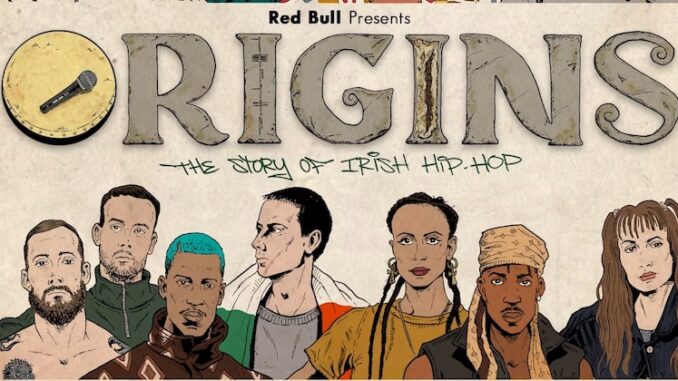
I’ll be honest. I came to this documentary late. By the time I sat down with Red Bull Presents: ORIGINS, The Story of Irish Hip Hop, the conversation around it had already run its course in most circles. The think pieces had been written, the social posts had cycled through, and the people who were going to watch it already had. But here’s the thing about a film that’s genuinely good: it doesn’t expire. It waits for you. And when I finally pressed play on this 52-minute document of defiance, community, and creative honesty, I found something that reminded me exactly why Hip Hop matters in the first place. Not the industry version. Not the algorithmic playlist version. The real one. The one built by people who had nothing but something to say.
Directed by Mark Logan and produced by COLLECTIVE Films for Red Bull, ORIGINS premiered on RTÉ One in September 2020 and now lives permanently on Red Bull TV, free to watch. It is the most comprehensive oral history of Hip Hop in Ireland ever assembled, pulling together artists, journalists, music industry figures, archivists, and fans across four decades of a scene that most people once dismissed as a contradiction in terms. The lineup of voices is extraordinary: Kneecap, Kojaque, Denise Chaila, Lethal Dialect, Blindboy, Scary Éire, God Knows, Jafaris, Nealo, Mango X Mathman, and many more. Between all of them, they tell a story that is specific to one small island on the edge of Europe, and because of that specificity, it ends up saying something universal about what Hip Hop actually is.
The Premise That Almost Wasn’t
The documentary opens with a tension that will feel familiar to anyone who grew up loving Hip Hop somewhere that wasn’t America. Writer and actor Emmet Kirwan comments, “Hip hop, for a long time, the idea of Irish hip hop was a misnomer,” one voice explains early in the film. “It was like, you can’t have Irish hip hop. That’s ridiculous.” That sentence lands differently depending on who you are. If you grew up in Dublin or Cork or Limerick or Athlone, you’ve probably heard some version of it. If you grew up anywhere that wasn’t New York or Los Angeles or Atlanta, you know the particular exhaustion of loving a genre that the gatekeepers said wasn’t yours to love.
Logan has talked about the genesis of the project beginning around 2017, when the scene was, in his words, “in its advanced infant stage.” What started as a conversation about a 15-minute online piece for Red Bull TV expanded quickly, as RTÉ came on board and the scene itself kept growing faster than anyone expected. Three years of filming later, the result is something that functions as a genuine time capsule. A document made at precisely the right moment, shaped by a filmmaker committed to letting the story find its own shape rather than arriving with one already written. “Don’t think you know the story because you don’t,” Logan has said about his approach. “You have an idea, that’s all you have, and you’ve got a gut feeling.” That openness is audible in every interview in the film. The people in front of the camera trusted the person behind it, and that trust is the invisible ingredient in every scene.
Scary Éire and the Permission to Sound Like Yourself
Any honest history of Hip Hop in Ireland has to start with Scary Éire, a group from Tullamore who are, by every account in the film, the foundational act of the entire Irish Hip Hop story. What they did was deceptively simple and, at the time, genuinely radical: they rapped in their own voices. Not American voices. Not approximated London voices. Their own actual Irish voices, with the full weight of where they were from sitting in every syllable.
People who were there describe the shock of it vividly. The beats carried traces of Public Enemy, Dr. Dre, UK dub, even punk, but the delivery was unmistakably Irish, and that combination had never existed before. What Scary Éire understood intuitively was that the energy and politics of Hip Hop translated perfectly to their context. They weren’t mimicking American content. They were channeling American technique into Irish experience, which is a completely different thing.
Island Records signed them. They supported U2. They were, briefly, on the verge of something enormous. Then Mr. Brown launched himself off Bono’s walkway in what the film describes with magnificent understatement as a kung fu kick into the crowd. A handwritten letter from Chris Blackwell arrived by fax the next morning. The deal was over. The film tells that story with the particular Irish combination of love, exasperation, and clear-eyed acceptance that being ahead of your time and being a liability can be the same thing.
But the legacy of Scary Éire is not the deal or the lack of it. The legacy is the permission they gave every Irish artist who came after them. The proof that you could rap in your own voice, from your own place, and not only have it work but have it be the whole point.
The Accent Question
If there is one thread that runs through every conversation in ORIGINS, it is the question of voice. Literal voice. The sound of where you are from coming out of your mouth when you rap. It seems like a simple thing. It is not.
Almost everyone in the documentary describes starting out rapping in an American or English accent, because that was all they had heard. That is just how influence works. You absorb what you love and you start sounding like it. The journey toward your own voice required something that felt almost like an act of will, a deliberate decision to stop hearing your own accent as a problem and start hearing it as the material. Several artists in the film describe that shift with a mix of humor and relief, the moment of catching their own accent on a recording and, instead of recoiling, leaning in.
What the film makes clear is that this is not just a stylistic choice. It is an artistic necessity. When an Irish MC builds a rhyme scheme around the specific sounds of a Dublin or Cork or Limerick accent, they create something that literally cannot be replicated by anyone else. The accent becomes the technology. It makes the work irreplaceable.
Lethal Dialect comes up repeatedly as the figure who made that undeniable for a generation of Dublin artists. He was among the first to rap in a full Dublin accent without softening it, and the effect on the artists who heard him was significant. Part of why it mattered so much is that the Dublin accent had always been used against working-class people in mainstream representations of Irish culture. Always the comic relief. Always the cautionary tale. The idea that someone could wield that same accent with total seriousness and total skill was, for a lot of people, a revelation.
Telling Your Own Stories
Hip Hop has always been, at its root, a literature. A practice of bearing witness. What ORIGINS argues, through the accumulation of voices across its runtime, is that Irish people were always going to be good at this, because the raw material was already there. The country has a deep tradition of bending language into shapes that carry more weight than the words alone should be able to carry, and that tradition runs through the artists in this film whether they can name it or not.
The shift the documentary tracks is the move from filtering Irish experience through an American lens to just describing Irish life directly. Songs about growing up in council estates. Songs about the housing crisis and the recession and the specific texture of trying to build a life in a city that sometimes feels designed to make that impossible. One artist in the film talks about hearing Mango X Mathman describe the experience of growing up on a generic suburban estate and realizing, for the first time, that his own environment had always been worth describing. That it held creative and emotional weight that he had never thought to claim. That kind of revelation is what Hip Hop makes possible when it is working the way it is supposed to work.
That is the heart of the documentary. Not just that Irish people can do Hip Hop. But that Hip Hop gave Irish people a form precise enough to hold the specific truth of their lives.
Vulnerability as a Radical Act
One of the most striking things about contemporary Irish Hip Hop, and something ORIGINS captures with real clarity, is how completely its artists have rejected the defensive masculinity that calcified around the genre in so many other places. The bravado, the posturing, the performed toughness; it is largely absent here, and not by accident.
Part of it is cultural. The recession stripped away a particular kind of national delusion about prosperity and institutions and who was actually looking out for whom. The referendums on marriage equality and abortion rights created a public atmosphere in which people were expected to say what they actually believed, openly, and be accountable to it. The artists who came up making music in that environment absorbed it. They arrived at their work with a different set of priorities, less interested in projecting invulnerability and more interested in telling the truth about what it actually feels like to be young and uncertain and alive in Ireland right now.
The audiences responded. The film captures moments of genuine excitement from artists describing crowds at their shows responding enthusiastically to lyrics about anxiety, self-doubt, and emotional difficulty. That response is not incidental. It reflects a generation of listeners who have been waiting for music that meets them where they actually are.
What Hip Hop Has Always Been About
Let me say something plainly. ORIGINS: The Story of Irish Hip Hop is a film about one of the foundational ideas of the genre: that your experience is worth documenting. That your voice, specifically your voice with its specific accent and its specific references and its specific way of landing a joke or sitting with a feeling, is the point. Not an approximation of someone else’s voice. Yours.
Hip Hop was built by people who felt unrepresented, who took the tools available to them and made something that had never existed before. That impulse does not belong to any one geography. It belongs to anyone willing to bring that kind of honesty and energy to the work. The artists in this documentary brought it. They took their accents and their estates and their anxieties and their complicated feelings about Ireland, and they built something genuine out of all of it.
What has come out of that is a scene of remarkable range. Kneecap’s bilingual provocation. Denise Chaila’s precision and power. Kojaque’s cinematic Dublin storytelling. Blindboy’s surrealist hyperbole with something devastating underneath. Nealo’s clear-eyed record of ordinary life. None of them sound like each other, and none of them sound like anyone from anywhere else. Ireland is too small for any of them to afford to. The result, as the documentary shows, is a scene that has earned attention not by chasing it but by being too specifically itself to be ignored.
That is what Hip Hop has always been about. That is what this film is about. And that is why, even if you are as late to it as I was, it is absolutely worth your time.
Origins: The Story of Irish Hip Hop is available to stream for free on Red Bull TV.



Leave a Reply