
Is the Akai MPC Sample Bringing Beatmaking Back to Where It Belongs?
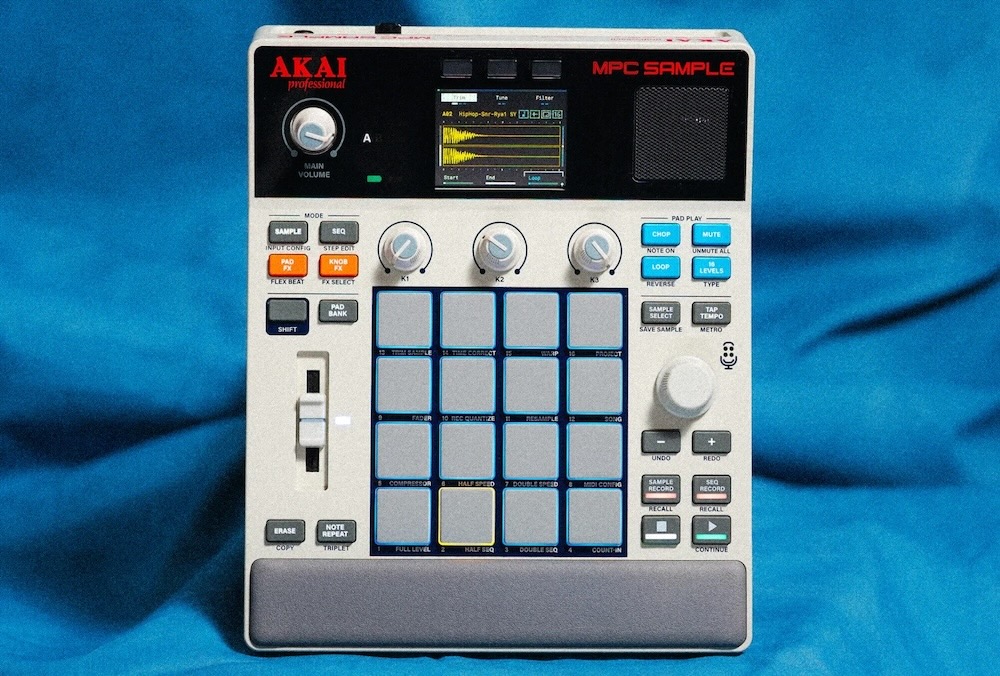
DJ Jazzy Jeff said it best. He posted a photo of the Akai MPC Sample on Facebook with six words that broke the internet: “I should NOT be able to make what I just made in my bed on headphones.” Four mind-blown emojis. That’s it. That’s the review.
When a man with that many crates, that many years, and that many degrees of respect for the craft reacts like that to a piece of gear, you stop scrolling.
What Is the Akai MPC Sample?
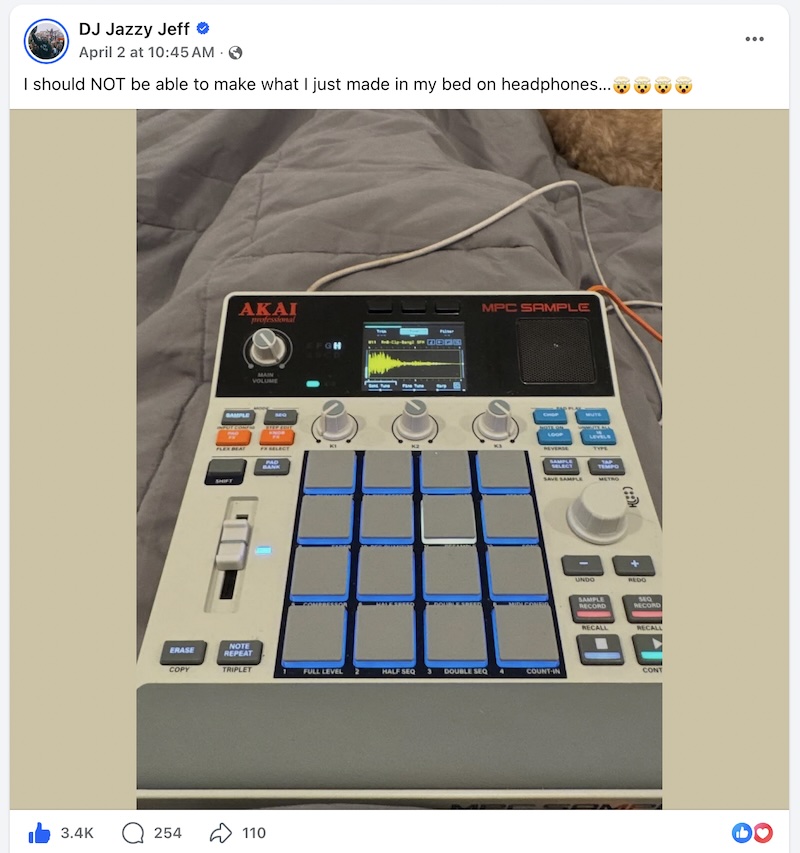
The MPC Sample is Akai’s newest standalone sampler, released March 24, 2026. It’s small enough to throw in a backpack. It runs on a rechargeable battery. It has a built-in microphone and a built-in speaker. It costs $399.

That’s the pitch. No laptop. No DAW. No power outlet. Just you, sixteen pads, and whatever sounds you decide to flip.
At 23.6 x 19.4 x 5 centimeters, the machine is roughly the size of an iPad. It ships with over 100 factory drum kits, 8GB of internal storage, a microSD slot, and four effects engines covering 60 effect types. The pads are RGB-backlit, velocity-sensitive, and include polyphonic aftertouch, which means you get expressive, dynamic control over every hit. Poly aftertouch at this price point is not something you take for granted. The sequencer runs at 960 PPQN with real-time swing, and disk streaming off the microSD means large sample projects don’t choke the machine’s 2GB of RAM. You connect audio sources via quarter-inch TRS inputs in the back, sample directly from your phone or laptop through USB-C, or just hold the thing up and use the built-in mic. The headphone output is an eighth-inch jack. MIDI in and out are handled via an included adapter.
What it does NOT have is the full plugin ecosystem, touch screen, XLR combo inputs, or deep DAW-in-a-box architecture of the flagship MPC line. It doesn’t do stems. It doesn’t do chord mode natively. It doesn’t have built-in instruments you can map to a MIDI keyboard and play like a synth. The keyboardist who wants to jam chords straight off the pads will hit a wall fast.
But that’s the point.
The Industry Forgot Something
Here’s the thing about the last ten years of music production hardware. Almost everything started moving toward the laptop. MPCs got bigger, more powerful, more complex. They added touchscreens. They added plugin support. They added Wi-Fi. Somewhere along the way, the flagship MPC became a desktop DAW in a box, not a tool you grab when inspiration hits at 2am.
The MPC XL, Akai’s other major 2026 release, is the ultimate version of that direction. It runs 16GB of RAM, 8-core processing, and sells for $2,899. It is an absolute monster for studio work. It is not something you bring to the park.
Meanwhile, a whole wave of smaller devices started stealing the culture’s attention. Roland’s SP-404MKII became the lo-fi producer’s best friend. Teenage Engineering’s EP-133 K.O. II turned into something people were genuinely excited to carry around. Producers wanted gear that felt tactile, immediate, and free from the gravitational pull of a computer monitor.
Akai watched all of that. The MPC Sample is their answer.
This Is Not the First Portable MPC. But It Might Be the Best One.
People forget that MPCs were always meant to be instruments first. The MPC60, designed by Roger Linn and released in 1988, was a sleek, beautiful machine. Producers carried it to sessions. DJ Premier heard one and knew immediately what it was going to do to hip-hop. It cost five thousand dollars, but people found a way.
Somewhere in the 2010s, the portable version of an MPC became an afterthought. The Live and Live II had battery power, but they were thick, heavy units still chasing the full-DAW vision. They were portable the way a loaded backpack is portable.
The MPC Sample is portable the way a notebook is portable. You pick it up, you leave the house, you make music.
The design even looks back. Akai went full nostalgia on the casing, bringing back the Pantone grey finish, the blue accents, and even the wrist rest cushion along the bottom panel, a detail from the original MPC60 that disappeared for decades. The Akai logo reverted to the old-school styling. Reviewers at MusicTech described it as a “head-turner,” and they’re not wrong. It looks like something between a Super Famicom and a piece of gear that made records you grew up on.
The new MPC 3 software architecture powering the machine adds Instant Sample Chop Mode, real-time timestretch, repitching, and a Color-Compressor with a retro saturation circuit built in. Akai is calling it “MPC grit.” You can run four effects engines simultaneously across Pad FX, Knob FX, and FlexBeat modes. You can resample internally with effects applied, layering and degrading sounds without ever leaving the device.
And when you’re ready to take a sketch further, MPC Sample projects load directly into Akai’s MPC 3 software on your computer. You build the idea on the road, you finish it in the studio.
What Producers Are Actually Saying
YouTuber L. Dre spent his own money, paid for one-day shipping, cracked the box open, and had a beat cooking before he even understood the menu system. His takeaway: “I literally just learned how to chop samples already by simply hitting chop and it kind of did it.” He compared the USB-C sampling workflow to every other piece of gear he owns and said this one felt instant. No hassle.
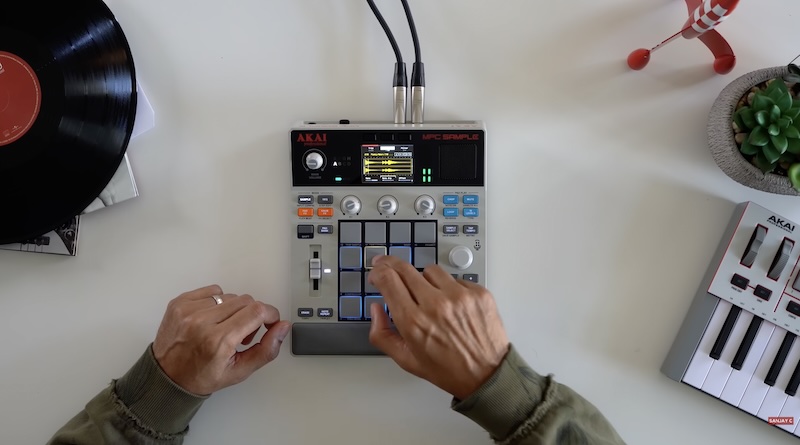
Sanjay C, another producer who tested the machine on camera, called it the first MPC that fits the “idea stage” of music creation. He pointed out that the balance it strikes between structured MPC sequencing and portable simplicity is something none of the competitors have quite nailed. The SP-404MKII has character effects for days, but the sequencing workflow is less intuitive. The KO2 is fun but lighter on features. The Ableton Move leans into DAW integration. The MPC Sample sits in the middle of all of them with a familiar MPC workflow, a screen that’s actually useful for waveform editing, and pads that feel like pads are supposed to feel.
One of the testers pointed out a small critique worth noting: the wrist rest cushion at the bottom of the unit looks great and fits the retro aesthetic, but it eats up real estate that could have gone toward larger pads. The pads on this machine are a touch smaller than what you get on the bigger MPC units. If you have big hands or do a lot of finger drumming, that’s worth knowing before you buy. While, we haven’t put our hands on the machine, from videos we’ve watched of people using it, the pads do look a bit cramped.
MPC Sample vs. the Competition
At $399, the MPC Sample sits in a crowded arena.
The Roland SP-404MKII goes for around the same price range and has a devoted fanbase because of its distinctive effects character and lo-fi processing. But it doesn’t give you the same structured sequencing workflow or the screen quality.
The Teenage Engineering EP-133 K.O. II is lighter and more playful, with a quirky interface that some people love and others find confusing. It runs on AA batteries, which gives it an edge in runtime, but those batteries cost money to keep replacing.
The Ableton Move, Elektron model:samples, and KORG volca sample 2 each occupy different lanes. None of them combine the MPC workflow, the screen, the poly aftertouch pads, the battery power, the built-in mic and speaker, and the $399 price in the same package.
The closest real competitor on pure spec-for-workflow value might be the MPC Sample itself.
Who This Machine Is For
If you already own an MPC Live II or the new MPC XL, this machine makes total sense as a travel companion. You sketch ideas on the road with a familiar workflow, then bring those projects home and expand them in your full setup.
If you’ve always wanted to get into the MPC ecosystem but couldn’t stomach $800 or more for a starting point, this is the door.
If you make lo-fi beats, boom-bap, sample-flip music, or anything rooted in the idea of flipping records and chopping loops, this machine was built for you.
If you need built-in synth instruments, complex plugin routing, or a full mixing environment, go look at something else. The Macbook Neo may be the starter machine for you around this price point.
The Bottom Line on the Akai MPC Sample
The MPC Sample doesn’t try to be a computer. That’s what makes it work.
In a decade where gear kept getting bigger and more connected and more dependent on a screen you had to sit down in front of, Akai went the other direction. They made something you hold in your hands. Something that fits in a bag. Something with a battery that lasts five hours and a speaker for auditioning sounds on the spot.
CDM’s comparison of the original 1988 MPC60 to the 2026 MPC Sample put it in perspective: the new machine is less than 9% of the original’s weight, under 3% of the inflation-adjusted cost, and holds over 10,000 times the sample storage.
DJ Jazzy Jeff made something in his bed on headphones that he felt should not have been possible.
For $399, that’s the whole argument.










4 thoughts on “Is the Akai MPC Sample Bringing Beatmaking Back to Where It Belongs?”