Gene Simmons, Hip Hop, and the Rock & Roll Hall of Fame Debate
If you type “Gene Simmons Hip Hop Rock and Roll Hall of Fame” into Google right now, you will see the same headlines over and over. Gene Simmons says rap does not belong in the Rock & Roll Hall of Fame. Gene Simmons doubles down. Gene Simmons says, “I don’t come from the ghetto.” The story is hot because it touches more than music. It touches history. It touches race. It touches who gets to decide what counts as American culture. And it touches something deeper about how people talk when they feel like their lane is being crowded. On the surface, this looks like a genre debate. Rock versus rap. Guitars versus turntables. Melody versus flow. That is how it is being framed in a lot of coverage. But if you listen closely to the words that were chosen, especially the word “ghetto,” it becomes clear that this is not just about categories. It is about perception. It is about distance. It is about who is seen as belonging in certain cultural spaces and who is treated like a guest. It was not just said that Hip Hop does not fit the label of “rock.” It was suggested that it does not speak the same language because of where it comes from. And that is where the problem begins.
Gene Simmons Says Rap Does Not Belong in the Rock and Roll Hall of Fame
Gene Simmons has made it clear that he believes Hip Hop should not be inducted into the Rock & Roll Hall of Fame. He argues that the institution’s name says “rock and roll,” and that other genres, including rap, opera, and symphonies, should not be included. He has pointed to Iron Maiden as an example of a rock band that sells out stadiums yet has not been inducted, while Hip Hop pioneers like Grandmaster Flash have been honored. That comparison has been used to frame the Hall as inconsistent. There has also been a rhetorical question asked about when Led Zeppelin might be inducted into a hypothetical Hip Hop Hall of Fame. The argument is presented as logical and consistent. Music has labels. Institutions have names. Therefore, the Hall should stick to its lane. On paper, that sounds simple enough. Many fans have complained about the Rock Hall’s choices over the years. Simmons himself criticized the Hall long before KISS was inducted calling it a joke. It has been said that it plays favorites. So frustration with the Hall is not new, and it is not limited to one genre. But something else was added to this argument. It was not just said that Hip Hop does not meet a genre definition. It was said that Hip Hop does not speak his language because he does not come from “the ghetto.” That word changed the tone completely.
The “Ghetto” Comment and What It Reveals
When Gene Simmons said, “I don’t come from the ghetto,” it was framed as an explanation for why Hip Hop does not connect with him. Later, it was defended by pointing out the word’s historical origins and by saying there was no racist intent. It was also stated that rock music itself is rooted in Black music, which was presented as proof that no bias was involved.
But intent and impact are not the same thing. The impact of that word cannot be separated from its modern meaning. In today’s American context, “ghetto” is not heard as a neutral geography term. It carries images of poverty, exclusion, and cultural otherness. By using that word as shorthand for Hip Hop, the genre was reduced to one narrow social picture. That is where the betrayal of the true feeling seems to sit. Because Hip Hop is not limited to one economic background or one neighborhood type. It is not defined by a single struggle narrative. It has always contained joy, humor, creativity, politics, love, storytelling, experimentation, and innovation. It has grown far beyond its birthplace while still honoring it. To frame it as something that comes from “the ghetto” and therefore does not speak a certain language suggests distance not just from the sound, but from the people associated with it. And when he mentioned Ice Cube was “a bright guy” who is respected, it came off with what can only be described as “I have a Black friend energy.” That tone was noticed. It felt like a shield rather than an argument. Compliments do not erase framing. They highlight it.
Rock and Roll Is a Black American Creation
One of the most frustrating parts of this debate is that rock and roll itself was created from Black American music traditions. Blues, gospel, rhythm and blues, and early soul shaped what would become rock. The guitar riffs, the vocal intensity, the performance style, the rhythmic backbone, all of it grew from Black innovation. That history has been widely documented and even acknowledged by Gene Simmons himself. It has been said plainly that rock owes everything to Black music. That is not controversial. It is fact. So when Hip Hop, another Black American art form, is treated as if it is outside the boundaries of rock’s cultural story, the logic becomes shaky.
American music has never evolved through isolation. It has evolved through borrowing, remixing, and responding. Jazz influenced rock. Funk influenced rock. Reggae influenced rock. Hip Hop has influenced rock for decades as well. Nu metal, rap rock, pop punk rhythms, even mainstream pop structures have been shaped by Hip Hop’s dominance. These genres have talked to each other constantly. To pretend that rock is a sealed category untouched by Hip Hop is to ignore fifty years of musical cross-pollination. And when the debate is framed as protecting rock from rap, it feels like protecting a house that was built by Black hands from another Black art form that came later. That is why the “ghetto” comment feels especially out of place. It suggests separation where history shows connection.
“Everything else other than rock, when rock ‘n’ roll splintered in the ’60s, is the roll. Soul music, reggae, hip-hop, which is rap music. Hip-hop is a culture, so it embodies sight, sound, story, and style. But music, the vocal on top of the music, has already been determined. So that’s the roll, that’s flow, that’s the soul in it. KISS are rock gods, but they don’t have a lot of roll to them.”
– Chuck D of Public Enemy
The Rock and Roll Hall of Fame Is About Influence and Impact
The Rock & Roll Hall of Fame has always been messy. Artists have been snubbed. Fans have complained. Metal has often been underrepresented. Punk has been debated. Pop artists have been inducted and criticized. Simmons himself criticized the Hall for years before accepting induction with KISS. That context shows that frustration with the institution is not new. But the Hall has never defined itself strictly by instrumentation. It has emphasized influence, cultural impact, and contribution to the evolution of popular music. By that measure, Hip Hop’s place is undeniable. Hip Hop has reshaped radio formats. It has influenced fashion, language, advertising, film, and global youth culture. It has produced some of the most influential artists of the last four decades. Stadium tours have been sold out. Global charts have been dominated. Cultural conversations have been driven by Hip Hop voices. The argument that it does not belong in a museum dedicated to the evolution of rock and roll feels narrow when rock and roll itself has always been about rebellion, innovation, and cultural disruption. That spirit is not limited to guitar driven bands. It is present wherever new sounds challenge the old guard. If influence is the metric, Hip Hop meets it easily. If cultural impact is the metric, it surpasses many traditional rock acts.
The “Just Talking” Narrative and Its Limits
In 2016, Simmons said that he was looking forward to the “death of rap,” and it was framed as a desire for music to return to melody instead of “just talking.” That framing lingers even if it is not repeated in the exact same words today. But describing Hip Hop as “just talking” misunderstands the art form. Flow is rhythm. Rhyme schemes require structure. Breath control demands skill. Internal rhyme and wordplay require creativity. Beat production involves composition, sampling, layering, and arrangement. Hooks often carry melody. Even when a track leans heavily into spoken cadence, the musicality is still present in timing and emphasis. Hip Hop has always included sung elements, from early hooks to modern melodic rap styles. And even if it were purely spoken, spoken word poetry has long been part of American artistic tradition. Blues storytelling was once dismissed. Jazz improvisation was once dismissed. Punk was once dismissed as noise. Every disruptive genre has faced claims that it is not “real music.” That cycle repeats because change feels threatening. But history tends to be kinder to innovation than critics are in the moment. When Hip Hop is reduced to “just talking,” it feels less like critique and more like refusal to engage deeply. It simplifies a complex form into a caricature. It also shows a pattern for Simmons.
MC Ren and Dr. Dre addressed Gene Simmons back in 2016 when N.W.A. was inducted into the Hall of Fame by saying “I want to say to Mr. Gene Simmons that Hip Hop is here forever.” with Dre following up with “We’re supposed to be here.”
MC Ren’s comments appear at 8:39 in the video.
Cultural Gatekeeping and the Language of Belonging
At the heart of this debate is the idea of belonging. Who belongs in the Rock & Roll Hall of Fame. Who belongs in the story of American music. Who belongs inside certain cultural institutions. When it is said that Hip Hop does not speak a certain language because of where it comes from, the line between taste and gatekeeping gets blurry. Personal taste is valid. Nobody has to enjoy every genre. But when taste is used to define institutional boundaries, it becomes something else. It becomes a statement about cultural legitimacy. The “ghetto” comment made that shift clear. It implied that Hip Hop is tied to a social space that feels foreign, and therefore less fitting for a mainstream honor. That is why the backlash has been strong. It is not only about genre. It is about what that word signals. It is about the long history of Black American art being celebrated in one form while questioned in another. Rock was once seen as dangerous. Jazz was once seen as improper. Blues was once dismissed as crude. Now those forms are honored as classics. Hip Hop stands in that same lineage of innovation. To argue that it does not belong in the Hall is to suggest that its influence does not count in the same way. And when that argument is tied to social language about “the ghetto,” it feels less like a debate over music and more like a debate over cultural worth. That is why this moment feels bigger than a podcast soundbite. It reveals how some lines are still being drawn, even in a world where genres have been blending for decades.
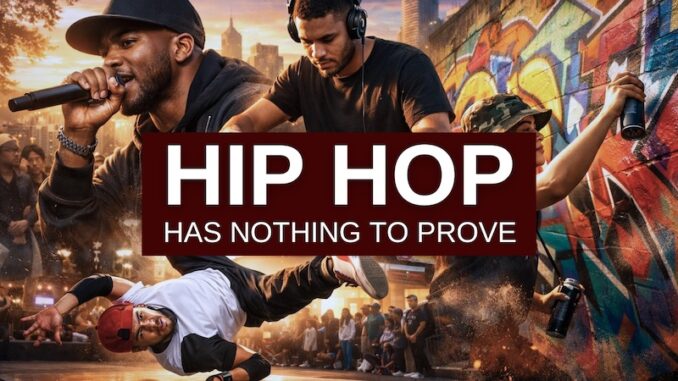
At the end of the day, Hip Hop has nothing to prove to Gene Simmons. It never did. In fifty years, Hip Hop has gone from block parties in the South Bronx to every corner of the globe — and it didn’t just travel, it connected. It made Black American life, struggle, joy, and genius felt by people who would otherwise never have encountered it. A kid in Tokyo, Korea, Lagos, São Paulo, or Paris didn’t just learn the words — they learned the world those words came from. They developed empathy, familiarity, and understanding that diplomacy, academia, and journalism couldn’t fully deliver on their own. That is empathy at scale. That is consciousness-raising without a podium. It is, in this writer’s opinion, the most important cultural movement since the Civil Rights Movement — not because of the charts it topped or the stadiums it filled, but because of the walls it quietly tore down across languages, borders, and generations. The “ghetto” Gene Simmons wants to keep at arm’s length is the same place that gave the world Rakim, Tupac, Biggie, Jay-Z, Kendrick Lamar, and a thousand artists still rising. No hall of fame validates that. No rock legend’s approval is required. Hip Hop built its own house, filled it with the whole world, and left the door open for anyone willing to listen.




Leave a Reply