
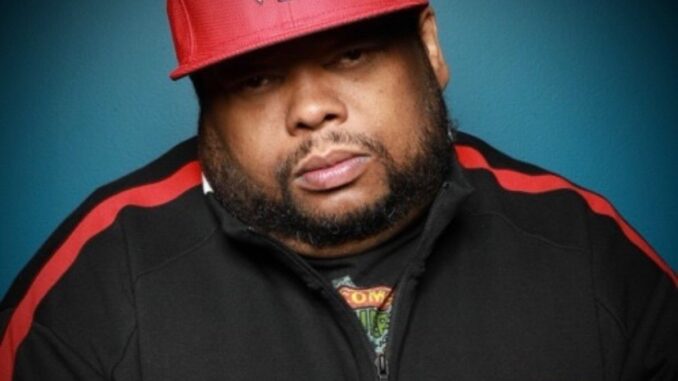
Steve Watson, the New York DJ and broadcaster known to the world as Lord Sear, died on March 11, 2026. He was 53 years old. No cause of death has been announced. He was still hosting his show at Shade 45 in the days before he passed. That fact alone tells you something about the man.
Lord Sear Helped Shape Hip Hop Radio for Three Decades
The announcement came through a joint post on Shade 45’s official channels, and the response from the Hip Hop community was immediate, wide, and deeply personal. Eminem, DJ Premier, Fat Joe, Busta Rhymes, Royce da 5’9″, Kool Keith, Yasiin Bey, Big Boi, Westside Gunn, Xzibit, Teddy Riley, E-40, and B-Real all came forward publicly. These are not people who move in the same circles, make the same music, or come from the same era. When artists that far apart on the map all show up for one person, you are looking at someone who meant something real to all of them, not someone who was simply well-known.
How Lord Sear Built His Name Before Anyone Was Watching
Steve Watson grew up in Harlem and came up in New York’s early 1990s underground scene. He ran under the aliases Stak Chedda and Lil Trey, was a core member of the collective known as the Constipated Monkeys, and eventually landed his first significant professional role as the touring DJ for rapper Kurious. That job put him on the road and gave him a working knowledge of live performance that most radio personalities never get. It also placed him close to the right people at the right time.
From there, Watson found his way into the orbit of The Stretch Armstrong and Bobbito Show on WKCR, Columbia University’s college radio station. He did not walk in as a co-host. He started by beatboxing, running logistics, bringing guests through the door. He did the work that needed doing before anyone was paying attention, and he did it well enough that his role grew. He eventually became an official co-host on a show that now carries the weight of genuine historical significance. The Stretch and Bobbito Show ran from 1990 to 1998 and served as the primary public platform for a generation of artists who would go on to define the genre. Jay-Z, Nas, Biggie Smalls, Wu-Tang Clan, The Fugees; all of them came through that studio. Questlove has said publicly that he spent years collecting recordings of that show and that half the freestyles he committed to memory came from those tapes. Sear was not a bystander in that room. He was part of the architecture.
The Stretch and Bobbito Show
To understand what Lord Sear contributed during the WKCR years, you have to understand what the show was doing in a landscape without streaming, without social media, and without any real mechanism for underground artists to reach an audience beyond their immediate geography. College radio, and specifically non-commercial college radio running late at night, was one of the only places where an unproven rapper could get airplay based entirely on skill. The Stretch and Bobbito Show operated without the constraints of commercial radio formatting, without the need to chase playlists or protect advertiser relationships. The standard was purely whether you could rap.
Sear’s presence on that show added a specific energy that complemented the format. He was known for his humor, for roasting callers and guests with a sharpness that required real cultural knowledge to land correctly. You cannot roast someone in a room full of Hip Hop heads unless you know the music deeply enough to know exactly what to go after. His humor was not performance. It was evidence of how thoroughly he understood the culture he was operating inside. The show introduced those legendary artists to a public that would carry them into the mainstream, and Sear helped create the atmosphere that made the show worth tuning into week after week.
Twenty Years at Shade 45
When Eminem launched Shade 45 on SiriusXM in 2004, the channel needed credibility. It needed voices that carried institutional weight from the underground, people who could convince artists and listeners alike that this was a real Hip Hop space and not a corporate product dressed up in street clothes. Sear was there from the beginning and stayed for over twenty years.
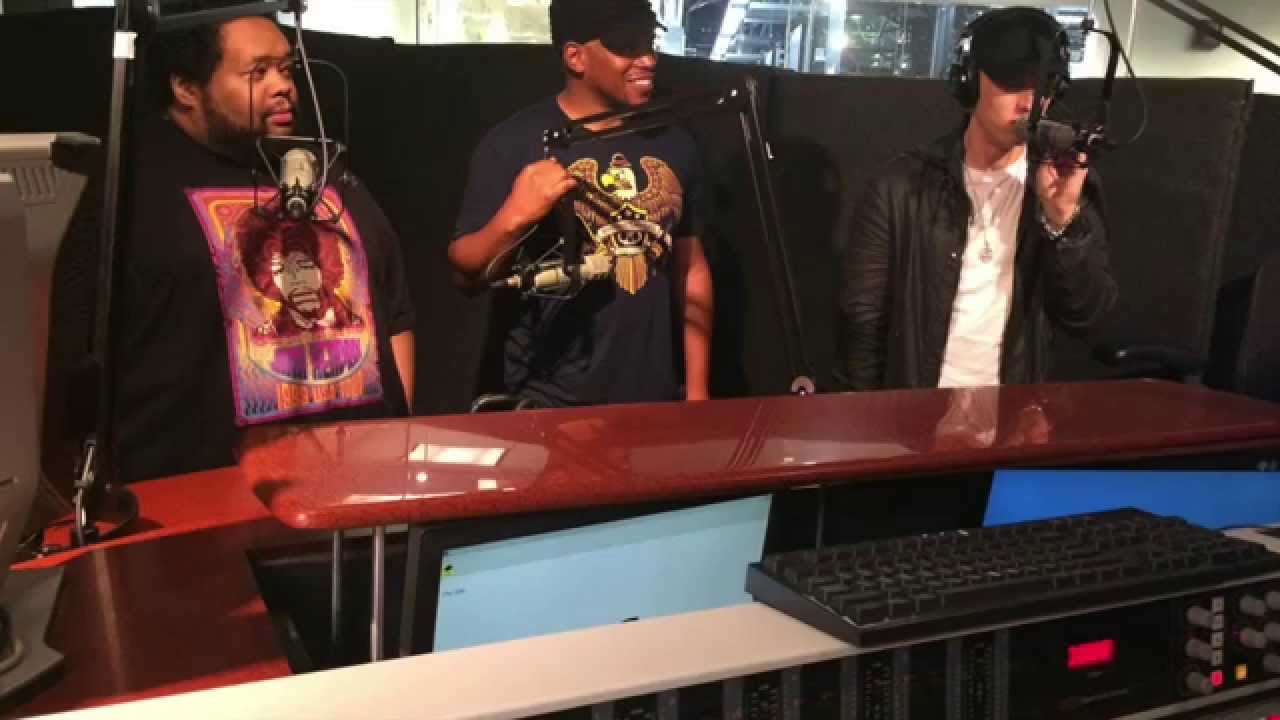
He co-hosted The All Out Show alongside Rude Jude, a program that carried the same spirit as the WKCR days; unfiltered conversation, a deep and wide musical rotation, no obligation to sand anything down for a general audience. He later took on The Lord Sear Special, a show he ran himself, which he was still hosting when he died. Two decades at one station is a remarkable tenure in any media environment. In satellite radio, where formats shift and personalities cycle through quickly, it is genuinely unusual. The fact that Sear maintained that presence without compromising the standards he had developed in the underground says something about both his talent and his character.
Eminem wrote that Sear was one of the greatest people to be around, that their time together at Shade 45 produced some of his favorite interviews, and that he would never forget how Sear made him laugh during the Anger Management Tour. Paul Rosenberg, Eminem’s longtime manager, wrote that when he moved to New York in 1996, Sear was one of his earliest friends, and that there were very few people as endearing, as genuinely funny, or as capable of making a room come alive the way that Sear could.
A Resume Built in the Margins of Classics
Lord Sear’s recorded work sits in the credits sections that most casual listeners skip over. That is precisely where he belongs, because that is where the people who actually build records live. He appeared on Hello Nasty by the Beastie Boys. He provided the intro to Yeeeah Baby by Big Pun. His voice appears on Vaudeville Villain, the MF DOOM project recorded under the Viktor Vaughn alias. He contributed to records by The X-Ecutioners and Statik Selektah. He released his own 12-inch singles; “Alcoholic Vibes / My Hindu Love” in 1997, and “Hello! (The Wake Up Call)” in 2000.
Then there is the Grand Theft Auto work, which reached a scale of audience that no amount of radio airtime could match. Sear voiced himself as a co-host on Game FM in Grand Theft Auto III in 2001 and returned for Grand Theft Auto IV in 2008. Rockstar Games acknowledged his passing specifically because of those contributions. For millions of players worldwide who had no connection to WKCR and no SiriusXM subscription, Lord Sear was the voice that taught them what New York radio actually sounded like. They just did not know his name yet. His presence in those games functioned as a cultural document, a recorded instance of a specific time and place in Hip Hop broadcasting that is now permanently preserved.
The Tributes
DJ Premier posted about their last conversation on March 9, two days before Sear died. B-Real from Cypress Hill wrote that he was having trouble processing that their brother was gone. Fat Joe, Ludacris, and E-40 commented publicly. Mickey Factz and Peter Rosenberg both shared their thoughts. The range of people who stepped forward tells you something specific about how Sear operated. He was not aligned with one faction of the culture or one geographic corner of it. He moved through all of it and was respected in all of it, which is harder to achieve than any single career accomplishment.
Shade 45 held a tribute broadcast on March 12 during Sear’s regular time slot, from noon to four in the afternoon. Friends, family, and listeners were invited to call in. It was a straightforward, human way to honor someone. No elaborate production. Just the people who loved him, on the air, during his hours.
Lord Sear’s Legacy
Hip Hop has a complicated relationship with its own history. It is a genre that invented the practice of sampling the past while simultaneously operating at a speed that makes it easy to forget the people who built what currently exists. Lord Sear spent thirty years working against that tendency, not by lecturing anyone about history, but by staying in the room and grinding. He was present at the Stretch and Bobbito sessions that helped launch a generation of legends. He was present at the founding of Shade 45 and remained there for its entire first two decades. He was still present the week he died.
The culture will keep moving, as it always does. But the infrastructure that shaped what Hip Hop radio sounded like, the standards that were set in a cramped studio at Columbia University in the early 1990s and carried forward into the satellite era, those were built by people like Steve Watson. He was one of the people who actually did it. Rest easy, Lord Sear.



Leave a Reply