
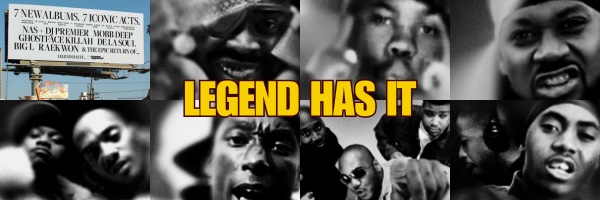
The year 2025 felt different from the very beginning. For a long time, the music industry has moved at a pace that feels almost impossible to track. New songs appear and disappear in a single weekend. Algorithms decide what we hear based on data rather than soul. However, as the months unfolded, a new rhythm began to take hold. It was a slower, more deliberate beat that demanded our attention. This change was not an accident. It was the result of a carefully planned journey through the heart of New York hip hop.
It started with a whisper in the spring and turned into a roar by the winter. Month after month, fans found themselves waiting for the next chapter of a story that felt both old and new. There were no frantic social media stunts or manufactured beefs. Instead, there was a sense of ceremony. Each release felt like an event, a moment to pause and appreciate the masters of a craft that has shaped global culture for over fifty years. This was the year that time slowed down just enough for us to hear the legends speak again.
The Vision of the Legend Has It Mass Appeal Series
The Legend Has It Mass Appeal series was an ambitious project organized by the independent label Mass Appeal and overseen by Nas. It was designed as a seven-part rollout that spanned the majority of 2025. The goal was simple but profound: to give the architects of East Coast hip hop a modern platform that respected their history while pushing their sound forward.
Before the first needle dropped, there was a vision of what this year could become. The trailer below serves as the mission statement for the Legend Has It Mass Appeal series, capturing the quiet intensity and the historical weight of the journey Nas and his team were about to undertake. It is a glimpse into the creative focus that defined the most significant movement in independent hip hop albums 2025.
In the current era of streaming, legacy artists are often treated like museum pieces. Their old hits are played on repeat, but their new work is frequently ignored by the mainstream machine. Mass Appeal took a different approach. By treating these releases as part of a unified series, they created a narrative that was impossible to ignore. Nas and his team proved that independent hip hop albums 2025 could compete for the spotlight by focusing on quality and cultural weight rather than chasing temporary trends.
The thesis of the series was clear. Mass Appeal did not view these artists as nostalgic acts. They treated them as active, evolving creators who still have plenty to say. This series was a statement that the foundation of the culture is not something to be left in the past. It is a living, breathing force that continues to provide the blueprint for the future.
Rollout as Curation
The success of the Legend Has It Mass Appeal series relied heavily on its rollout strategy. Rather than dropping all the music at once, the label chose a monthly rhythm. This staggered approach allowed each artist to have their own moment in the sun. In a world where we are used to consuming everything instantly, this required a level of cultural patience from the audience.
This was curation in its truest form. By spacing the albums out, Mass Appeal forced the listener to live with the music. You couldn’t just skim through the series in an afternoon. You had to wait, anticipate, and then digest each project before the next one arrived. This directly connected to the approach of Nas Mass Appeal 2025, where the focus was on the long-term health of the culture rather than short-term profit. It was a direct contrast to the habit of “dumping” music onto platforms and hoping something sticks to the wall.
The Lineup and Cultural Weight
The lineup for the series was a “who’s who” of New York excellence. It included Slick Rick, Raekwon, Ghostface Killah, Mobb Deep, Big L, De La Soul, and finally, a collaborative project from Nas and DJ Premier. Individually, these names represent the gold standard of lyricism and production. Together, they form the backbone of the New York hip hop lineage.
The cultural weight of this group cannot be overstated. These are the artists who defined the aesthetics of the 1990s and beyond. They introduced the world to complex storytelling, cinematic street narratives, and the art of the sample. By bringing them together under one banner, Mass Appeal reminded the world that these hip hop legacy artists are the reason the genre exists in its current form. The series functioned as a bridge, connecting the “Golden Era” to the modern day without losing the essence of what made the music special in the first place.
The Year in Chapters
Slick Rick – Victory (June 13, 2025)
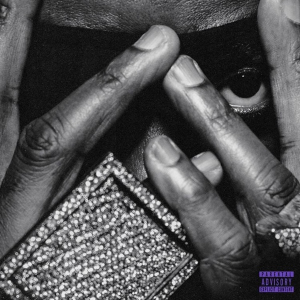
It made sense that Victory opened the series. Slick Rick is one of those artists who changed hip hop without needing a giant discography. He helped set the rules for narrative rap, then basically stepped back and let the culture keep borrowing his tools.
This was a true multimedia event, accompanied by a 30-minute visual album film directed by Meji Alabi and executive-produced by Idris Elba. The film, which premiered at the Tribeca Festival, used high-concept cinematography to bring Rick’s storytelling to life across London and NYC. By launching the Legend Has It Mass Appeal series with a literal film, Nas and Rick signaled that this year was about treating hip hop as high art.
So when Victory arrived on June 13, it did not feel like a “comeback” album in the corny sense. It felt like an artist returning with control. The project was executive-produced by Slick Rick and Idris Elba, and it was framed as a visual album with an accompanying film.
Musically, the album is short and intentionally tight at 27 minutes. That brevity becomes part of its personality. Rick slides in, tells you what he wants to tell you, and exits before the moment can get overexplained.
What stands out is how Victory treats genre like a palette instead of a fence. There’s boom-bap, yes, but the project also leans into reggae and house textures. The result is not “trying to sound modern.” It’s more like: this is what he likes, and always did.
The guest list is small but purposeful. Nas appears, along with Giggs and Estelle. The closer “Another Great Adventure” is produced by Q-Tip, which feels like a quiet nod to the larger New York creative circle that Mass Appeal was building across the year.
Central takeaway: Victory doesn’t argue for Slick Rick’s importance. It behaves like it already knows. That confidence set the tone for the whole series.
Raekwon – The Emperor’s New Clothes (July 18, 2025)
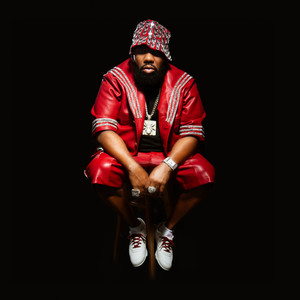
Raekwon’s The Emperor’s New Clothes arrived next on July 18, and it played like a veteran’s album in the best way. It’s 17 tracks and a little over 40 minutes, and it sits comfortably in Raekwon’s lane: cinematic street scenes, luxury details, coded language, and a voice that still sounds built for close-range storytelling.
The production roster is stacked with familiar names and dependable craftsmanship, including Swizz Beatz, Nottz, and J.U.S.T.I.C.E. League. The album isn’t a futuristic pivot. It’s The Chef doing what he has always done, but with cleaner edges and more control in the mix. Clocking in at just over 40 minutes, the album benefits from a wide but cohesive production lineup that includes Swizz Beatz, Nottz, and J.U.S.T.I.C.E. League, reinforcing its sense of polish without sanding down Raekwon’s grit.
Features do a lot of the work in terms of texture and generation-bridging. Nas appears, as do Wu-Tang affiliates like Ghostface Killah, Method Man, and Inspectah Deck. And the presence of Griselda helps place Raekwon’s influence in the present tense. It’s not forced. It’s more like hearing the echoes come back.
This album’s role inside the series is important. It’s the chapter that says: we’re not here for museum rap. We’re here for living craft. Raekwon isn’t rewriting his identity. He’s sharpening it.
Central takeaway: The Emperor’s New Clothes treats mafioso rap less like a costume and more like a language Rae never stopped speaking, even while the culture moved around him.
Ghostface Killah – Supreme Clientele 2 (August 22, 2025)
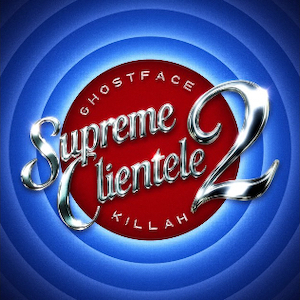
When you name an album Supreme Clientele 2, you are asking for a specific kind of attention. Ghostface didn’t need that pressure, but he stepped into it anyway.
The album dropped August 22. It’s long on paper, 22 tracks and just under 49 minutes, but it’s built in quick bursts. A lot of songs run under two minutes. It feels like a collage of scenes, not a single long narrative. With 22 tracks arranged more like snapshots than chapters, the album leans into Ghostface’s instinct for vivid moments rather than a single, uninterrupted narrative arc. That can be energizing. It can also feel scattered if you listen in a hurry.
What’s undeniable is the cast. Nas is here. So are Conway the Machine, Styles P, M.O.P., Redman, and a strong set of Wu-Tang collaborators including Raekwon, Method Man, and GZA. That lineup places Ghostface where he has always thrived: in conversation. He’s at his best when a track becomes a room full of voices and he’s still the one painting the sharpest picture.
Inside the larger rollout, this album does something subtle. It reframes sequel culture. This isn’t the sequel as a cash-in. It’s the sequel as a reminder that a classic era can be revisited if you treat it like a living reference point, not a sacred text.
Central takeaway: Supreme Clientele 2 isn’t about recreating 2000. It’s about proving Ghostface can still build a world fast, in fragments, and make you believe each one.
Mobb Deep – Infinite (October 10, 2025)
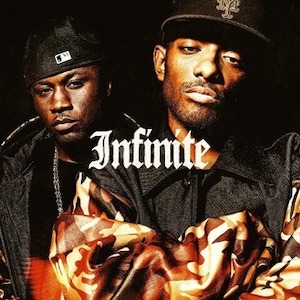
If the earlier chapters were about living icons returning to the mic, Infinite from Mobb Deep was about absence, and about how carefully absence can be handled.
Released October 10, the album runs 15 tracks and about 51 minutes. It’s built around unreleased Prodigy vocals, assembled and produced by Havoc with support from The Alchemist. That kind of project can easily go wrong. A lot of posthumous albums feel like vault raids. This one was widely seen as more respectful than exploitative, largely because the choices feel measured.
The production matters. Havoc carries most of the sonic weight, with The Alchemist contributing too, and the album leans into that familiar Queensbridge mood: stark drums, cold loops, and space around the verses. Not flashy. Not over-designed. It sounds like the kind of record meant to be played loud, then replayed.
The guest list also reads like a map of Mobb Deep’s orbit. Nas appears several times. Raekwon and Ghostface show up together on “Clear Black Nights,” which is a neat echo of earlier Mobb and Wu-Tang intersections. Clipse also appears on “Look at Me,” giving the album a sharp edge without changing its core identity. There are also smoother touches through the presence of singers like Jorja Smith and H.E.R. on different versions of “Down for You,” which adds contrast without sanding down the grit.
Central takeaway: Infinite shows what it looks like when posthumous work is treated like stewardship. Prodigy’s voice wasn’t forced into a new era. It was allowed to stand where it always stood: uncompromising.
Big L – Harlem’s Finest: Return of the King (October 31, 2025)
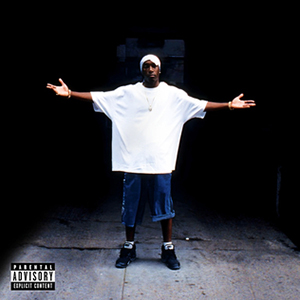
Big L’s chapter is the hardest one to talk about cleanly, because the story is already heavy. He’s been gone since 1999, but his name still gets spoken like a benchmark for punchlines and freestyle dominance.
Harlem’s Finest: Return of the King arrived October 31 as the fifth entry in the series. It’s a posthumous project built from unreleased and rare material, positioned as a tribute that also functions as a restoration.
One of the most important elements is the cleaned-up presentation of the “7 Minute Freestyle” with Jay-Z, a moment that has lived in bootleg form for years and now shows up with higher clarity. The album also includes “Forever,” a track featuring Mac Miller, made possible through cooperation between estates.
This is where posthumous projects get tricky. Vocals pulled from different moments in time can create an uneven feel once they’re placed into a new sequence. And there’s always the ethical question: is this honoring the artist, or just mining the archive? Here, the result lands as a mixed but respectful offering. Even when the construction shows its seams, Big L’s talent still cuts through. His voice is the point.
Central takeaway: Harlem’s Finest functions like restoration work. It won’t replace the myth, and it shouldn’t try. But it puts Big L’s skill in front of new listeners who only knew the legend secondhand.
De La Soul – Cabin in the Sky (November 21, 2025)

Where some legacy projects lean into grit, De La Soul’s Cabin in the Sky leans into life. That’s what makes it hit so hard.
Released November 21, it’s a 20-track album and the group’s first full-length in years. It also arrived after the loss of Trugoy the Dove, and that context is unavoidable. Still, the record doesn’t feel frozen by grief. His presence remains part of the project through previously recorded vocals and production contributions, which helps the album feel like continuation rather than absence.
The production credits show how intentionally the album was framed. DJ Premier is involved. Pete Rock is involved, and he produced the lead single “The Package.” The sound is warm and soulful, rooted in classic textures without sounding stuck in the past.
The guest list is wide but coherent. Killer Mike, Common, Nas, Black Thought, and Yukimi from Little Dragon all appear, among others. It’s a mix that fits De La’s whole history: playful and serious, political and personal, grounded and slightly surreal.
Central takeaway: Cabin in the Sky doesn’t present survival as a trophy. It presents it as a practice. That’s why it feels so human inside a series built around legend.
Nas & DJ Premier – Light-Years (December 12, 2025)
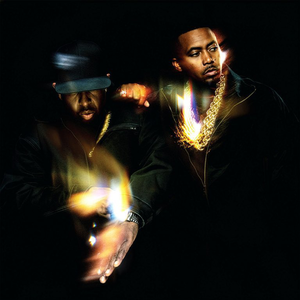
Ending the series with Nas and DJ Premier was almost too perfect, which is probably why it worked. You can feel the weight of history here, but the album doesn’t lean on it like a crutch.
Light-Years was released December 12 as the final entry in the rollout. It’s fully produced by Premier, and the backstory stretches across years, with recording sessions spanning a long timeline before the project finally came together as a complete album. This pairing has been one the fans have been asking for for decades.
The guest list is selective for a “monument” record. One of the album’s quiet curveballs is a collaboration with the Steve Miller Band, an unexpected pairing that widens the album’s palette without pulling it away from its boom-bap core. AZ appears, which feels like a natural connection point for Nas, and there’s also a surprising collaboration with the Steve Miller Band. That odd pairing is part of what keeps the project from feeling like a closed loop. It’s not trying to be a museum piece. It’s trying to be a record that lives now.
A few track titles hint at the themes before you even hit play: “Pause Tapes,” “Writers,” “Sons (Young Kings).” They point toward memory, craft, and responsibility, which fits the role of this album as the capstone. Critics also highlighted those themes as part of the album’s emotional center.
Central takeaway: Light-Years doesn’t sound like Nas chasing his past. It sounds like two masters using the past as a tool, then building forward from there.
Themes That Connected the Series
While each album in the series had its own unique flavor, several themes tied them all together. First and foremost was the role of New York as a cultural anchor. Every artist in the lineup is deeply rooted in the five boroughs, and the music reflected the energy, grit, and sophistication of the city.
Another major theme was cross-generational collaboration. Throughout the year, we saw younger producers and artists paying tribute to their elders, not by imitating them, but by providing a modern canvas for their work. There was also a strong focus on archival restoration versus reinvention. Projects like those from Mobb Deep and Big L showed how unreleased material can be handled with the utmost respect, ensuring that a legacy is preserved rather than exploited. Above all, the series emphasized storytelling as a shared value, proving that the ability to weave a narrative remains the most powerful tool in a rapper’s arsenal.
Beyond Albums: The Marvel Tie-In
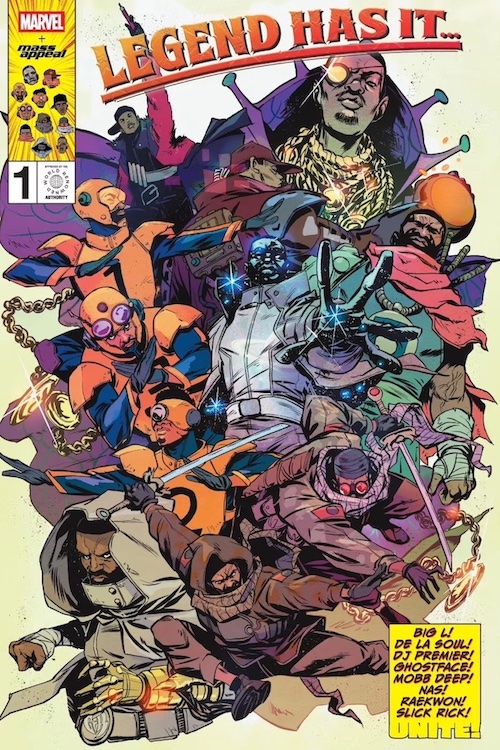
The Legend Has It Mass Appeal series was about more than just digital files on a streaming service. It was an exercise in world-building. One of the most significant aspects of the rollout was the collaboration with Marvel Comics. This partnership reimagined the seven artists as superheroes, complete with limited-edition comic book covers and a special issue debuted at New York Comic Con.
This wasn’t just a clever branding gimmick. It was a narrative expansion. By framing these artists as larger-than-life figures in a superhero universe, Mass Appeal and Marvel tapped into the idea that hip hop artists have always been the “superheroes” of their communities. They are figures who turn struggle into power and use their voices to inspire others. The visual identity of the series, from the album art to the comic panels, created a cohesive universe that fans could inhabit throughout the year.
Reception and Cultural Framing
The reception to the series was overwhelmingly positive, but more importantly, it was thoughtful. Critics and fans alike treated the music with a level of respect that is often missing in today’s fast-paced media cycle. There was a sense that we were witnessing a historical moment in real time.
The closing album, Light Years, functioned as more than just a musical release. it was a victory lap for the entire concept. The conversation surrounding the series wasn’t about who had the most streams or who was “trending” on social media. Instead, the discussion focused on the quality of the lyrics, the depth of the production, and the significance of seeing these icons still working at such a high level. It shifted the cultural framing of legacy hip hop from “old” to “essential.”
What This Suggests for the Future
The success of the Legend Has It Mass Appeal series offers a new blueprint for the music industry. It suggests that independent labels can find great success by slowing down and focusing on long-form rollouts. By treating music as a curated experience rather than a commodity, labels can build deeper connections with their audiences.
It also changes how we think about legacy artists. This series proved that there is a massive, hungry audience for mature, high-quality hip hop that doesn’t rely on youthful trends. It shows that hip hop is a living culture that can support its pioneers just as well as its newcomers. Moving forward, we may see more “narrative-driven” releases that prioritize the story of the artist as much as the music itself.
When we look back at the Legend Has It Mass Appeal series, we will remember it as the year hip hop took a deep breath. It was a time when the culture looked at its foundation and found that it was stronger than ever. Through the vision of Nas Mass Appeal 2025, seven chapters were written that reminded us of the power of intention and the value of time.
This series was never about isolated releases or chasing a single hit. It was a cultural conversation that honored the past while confidently stepping into the future. It proved that when you treat the legends with the respect they deserve, the music becomes something that lasts far longer than a weekend. It becomes a legacy that is truly light years ahead.





Leave a Reply