
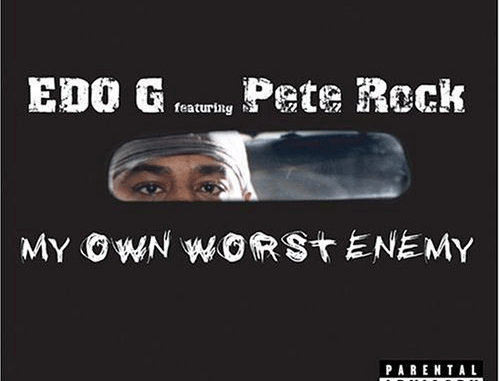
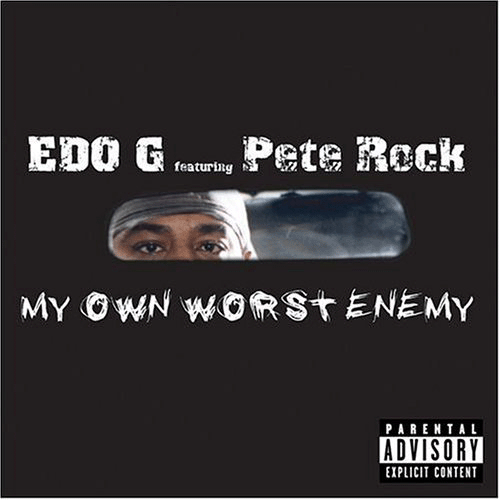
Artist: Edo G Album: My Own Worst Enemy
Label: Fat Beats
Edo G. is not trying to get any younger on his latest offering. My Own Worst Enemy is not about some old dude trying to make a comeback. The comeback is finished, and Edo’s not trying to prove anything. He’s just showing you what he is. And he’s showing you that getting older isn’t a setback. This is grown-up shit, and amidst an industry too prevalent with music made for 16-year-olds, it’s damn refreshing.
One of the strengths of the album is Edo’s return to a rule that has accompanied his best album work: stick to one DJ or production team. His debut, the 1991 commercial hit Life of A Kid in the Ghetto, utilized the production of the Awesome 2 family; his 1993 follow-up, the relatively unsuccessful Roxbury 02119, used the same production team on several tracks, but added the Diggin in the Crates production of Diamond D for most of the other songs. After falling off, then emerging again on compilations and guest spots, Edo returned with The Truth Hurts in 2001. A fine exhibition of Edo’s skills, it was unfortunately somewhat diluted by the eclectic collection of producers featured on the album – few of whom approached the stellar quality of DJ Premier’s lone track, the single “Sayin’ Something.” Edo’s next album, Wishful Thinking, was significantly shorter than The Truth Hurts, but, produced almost completely by DJ Supreme One, it successfully electrified Edo’s lyrics with a consistent funk-heaviness. So it’s not surprising that My Own Worst Enemy is produced predominantly by one DJ/producer: this time, the seemingly ageless Pete Rock.
And it works. Pete Rock brings his signature jazz-induced stylings to the album, a departure from the funk of Wishful Thinking, and Edo’s harsh, deep staccato vocals juxtapose the smooth, minimalist production of the Soul Brother #1. Refreshingly, there’s no singing on this album: all the hooks and choruses are either plain rapping or sample-driven. It’s just MCs spitting and DJs producing, and it proves that an album of just pure hip-hop can be so fucking good. Also reminiscent of hip-hop albums from an earlier era, all the guest appearances are from those firmly within Edo’s camp. A frequent contributor is Jaysaun, a member of Edo’s new Special Teams group (as well as his own outfit, The Kreators), emerging as an apt pupil who invokes Edo’s abrupt, direct style. He sounds young, but perhaps that’s on purpose: Edo comes across as a mature veteran on the album, and one thankfully unobsessed with his star status. Instead, he uses the album as a reflection on his life, an opportunity to imbue the youth – hopefully including Jaysaun – with the lessons it has given him. Edo got screwed label-wise after the initial success of Life of a Kid in the Ghetto before resurfacing on the independent/underground circuit, so the album itself is a demonstration itself of the evolution of his personal business approach.
The lessons Edo brings to the album do not necessarily set it apart: keep learning about yourself and the world around you, don’t fuck up, don’t fuck with me, work hard, don’t forget where you come from, and above all, be honest. The honesty of the album is one of the reasons this album is special. On the first track, “Boston,” Edo actually cites why people might be skeptical as to whether he’s still relevant, and then addresses their concerns with real answers, not just fuck-yous. No one I can think of does this. “Your second joint / a sad sequel / you an old school rapper / who mad feeble” – that’s Edo talking about himself: he’s confessed that he liked some of the tracks on his sophomore Roxbury 02119, but that he felt several of its songs were just filler. He doesn’t refute that here, but several lines later, addresses such naysayers “I’m a throwback from the nineties / whose return is timely / for hip-hop consciousness that’s grimy.” Next verse: “My work ethic dispersed effort from my worst to my first effort / There’s a madness to my method / it’s universal / my music / is underground and commercial / wholesome and controversial.” He’s not relevant because he used to be something; he’s relevant because of what he has to say now.
Pete Rock, a veteran of the same era Edo blew up in, also demonstrates early on in the album why he’s still relevant. “Boston” is a guaranteed head-nodder, “Just Call My Name” speaks on why the talents of Edo, Jaysaun, and Pete should not be taken for granted, and “Voices” – although at first sounding so relaxed as if to potentially signify a downturn in the album – picks up as Edo fills in the spaces between the slow beat with the melancholy reflections of a man who knows his past mistakes but is trying to get his life right, despite internal and outside forces acting against him. But then Track #4 hits. And when I say it hits, that’s no metaphor: it slaps you in the face. From the Busta Rhymes sample that marks the beginning of the song, this shit is LIVE. Frenetic, bouncing-off-the-walls shit. If ever there was an example of how easily Edo could resign himself to merely manufacturing club hits, this is it. The next track, “Streets is Callin,” could in fact be a rejection of the prospect of pandering to the dance floor, as it returns to the sit-at-home listening sound of the first three songs. Perhaps that quick transition is itself another lesson: Edo has stated in interviews that the hip-hop divide he sees between “commercial” songs and those produced for college-age fans of underground/independent hip-hop boils down to whether songs make you want to dance. The quick transition between the two here serves as a reminder to his head-nodding audience that there’s more to club tunes than they give credit for.
But while the politics of My Own Worst Enemy is subtle through the first six tracks, those of “Wishing” blow you over. You know this song is going to be different when Masta Ace opens with “I wish the president would stop lying / I wish black babies would stop dying” The song offers a telling contrast with Jadakiss’s hit “Why” from earlier in 2004: both songs are overtly political, and both rely on a single, line-opening phrase to drive the song. I liked “Why,” but while Jada asked questions without providing answers, these verses – from two hip-hop elders – present problems without the youthful naiveté that seeks immediate answers. The two MCs here couple their political thoughts with mournful reflection. There are no easy solutions to all the problems Edo and Ace present on this song – to satisfy many of them, the audience, and the people of world, must simply evolve into a better, more mindful, population. This is anti-Bush without being propaganda, as Edo breaks his politics down to the language, and logic, of the streets and of events in his life: “I wish I didn’t get searched when I come through customs / I wish Christians’d stop beefing with Muslims / Wish the poor didn’t have to take welfare / Wish America had universal healthcare.” One of the reasons this song is so powerful is its combination of the personal and the political. That the lines “I wish my pops didn’t die when I was seven years old” and “I wish I’d been more diligent” are expressed with as much emotional weight as anti-Bush, anti-discrimination statements shows us how much this stuff means to Edo. Once considered a “conscious” rapper, this is the only song on the album that hearkens back to the idealist political themes of many of rap’s golden-age acts. And it’s the only one that we need, it’s just that good.
The next two songs, “Right Now!” and “Stop Dat,” return to the lesson-giving, don’t-fuck-with-me-cuz-I’m-that-good-and-here’s-why themes presented so adequately by Edo and Pete earlier in the album. But just as you get a little relaxed – a little comfortable – with the smooth “Stop Dat,” the thump hits again with “Revolution.” A hard beat coupled with a captivating piano-synth loop and guest producer DJ Revolution’s samples of Edo himself, it ends up being the perfect conclusion to the album, as Edo raps accurately how, in case you hadn’t already figured it out by now, he ranks among the pantheon of hip-hop. He does not, however, shy away from the cynicism pervasive throughout the album, about the state of rap as well as the state of the world. Who but a cynic would have the gumption to end his album with “Fuck rappin / cuz the best things happen / to the people who make the best of what happens / without jaw flappin, scrappin / not enough soldiers and too many captains / I got a rare gift…”? Perhaps this is why the album was entitled My Own Worst Enemy: because Edo G. recognizes that his relative success due to hard work cannot be duplicated by anyone who works hard – that he is, in fact, lucky to have this rare gift, and that his success is a double-edged sword when attempting to teach the youth. The world simply cannot accommodate all the ambition within it. As much as that “if you try hard enough” bullshit is fed down our throats, trying hard does not guarantee success. Edo G., you know this. Thanks.




Leave a Reply