
Hip Hop as Memory, Mirror, and Momentum
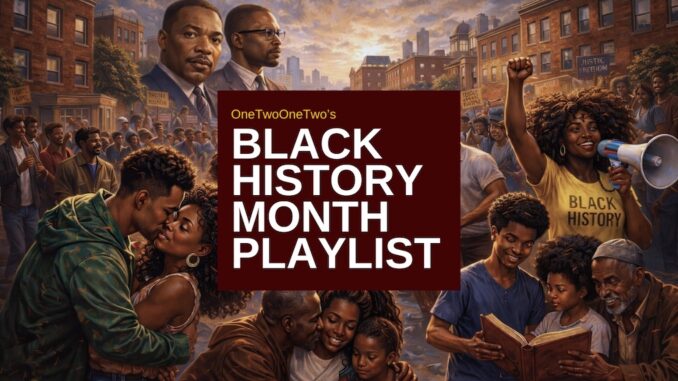
Black History Month is often framed as reflection—looking back, honoring names, marking moments. Hip Hop has always done something slightly different. From its earliest recordings, it didn’t just document history; it argued with it, expanded it, and projected it forward. Rap music has functioned as oral history, neighborhood journalism, spiritual affirmation, political critique, and love letter—all at once.
This Black History Month playlist isn’t meant to be exhaustive or definitive. It’s a cross-generational conversation, moving from the early architecture of Hip Hop’s social voice to its modern inheritors. Some of these records are confrontational. Others are tender. Some teach explicitly, some inspire quietly. Together, they reflect Hip Hop’s full capacity to hold Black truth without flattening it.
Selected Highlights
What stands out across this playlist is how Hip Hop continues to speak in multiple registers at once. Some records arrive as affirmation, others as challenge, but none of them feel isolated. When Nas declares “Ultra Black,” he isn’t making an argument so much as stating a fact. It’s a reminder that pride doesn’t always need to announce itself loudly; sometimes it shows up as steadiness, continuity, and confidence earned over time.
That sense of grounded clarity sits alongside moments of collective urgency. “Fight the Power” remains essential not because it represents anger, but because it represents focus. Public Enemy didn’t just express frustration—they gave it shape, language, and direction. Decades later, that energy echoes in records like Kendrick Lamar’s “Alright,” where resilience becomes communal rather than individual, something people can chant together when words feel insufficient.
Other songs in this collection work less like slogans and more like lessons. With “Mathematics” Mos Def turns statistics into lived experience, refusing to let numbers stay abstract. Tracks like KRS‘ “You Must Learn” and Joey Bada$$‘ “Land of the Free” reinforce the idea that history isn’t something we visit—it’s something we’re already standing inside. Knowledge, in this context, isn’t academic; it’s practical and necessary.
There’s also space here for tenderness and care. Hip Hop’s role in Black history isn’t limited to protest—it includes love, healing, and imagination. Songs like “Brown Skin Lady,” “Liberation,” and “I Can”, by Black Star, Outkast ft. Cee-Lo Green, and Nas; respectively, remind listeners that upliftment can be gentle, aspirational, and forward-facing. They imagine futures without pretending the present is easy.
Taken together, these songs don’t tell a single story. They form a conversation across generations, one where elders, peers, and younger voices speak to each other rather than past one another. That ongoing dialogue—sometimes urgent, sometimes reflective—is part of what makes Hip Hop not just a soundtrack to Black history, but one of its most consistent narrators.
Black History Month Playlist Tracks Guide
- Ultra Black – Nas (feat. Hit-Boy)
Nas opens the playlist in elder-statesman mode, speaking from continuity rather than reaction. As one of Hip Hop’s most enduring chroniclers, he uses this track to affirm Black excellence as a lived reality, not a slogan. - Proud to Be Black – Run-D.M.C.
Run-D.M.C. recorded this at a moment when Hip Hop was still negotiating visibility. Their decision to state Black pride plainly, without metaphor, helped normalize cultural affirmation in mainstream rap spaces. - Fight the Power – Public Enemy
Chuck D and Public Enemy transformed rap into organized resistance with this record. The group’s militant clarity established Hip Hop as a legitimate political force, not just cultural commentary. - We Were Never the Problem – Timid
Timid approaches Hip Hop as corrective history. His writing centers systems over stereotypes, placing contemporary injustice into a longer historical framework without dramatics or dilution. - Black Lives Matter – Royce da 5’9″ (feat. Big K.R.I.T.)
Royce da 5’9” delivers sharp, reflective verses rooted in lived experience, while Big K.R.I.T. adds Southern perspective and spiritual grounding. Together, they frame protest as thought, not noise. - Alright – Kendrick Lamar
Kendrick Lamar’s work often sits at the intersection of pain and transcendence. “Alright” became a communal expression of endurance, not because it denies hardship, but because it names survival as collective strength. - Black America Again – Common (feat. Stevie Wonder)
Common has long positioned himself as Hip Hop’s moral witness. On this track, he reflects on cyclical progress and regression, situating modern struggles within historical patterns. - The Message – Grandmaster Flash and the Furious Five
Melle Mel’s verses helped establish Hip Hop as social documentation. This song remains one of the clearest examples of rap functioning as first-person historical record. - I’m Black – Styles P
Styles P approaches Black identity from a grounded, street-level perspective. His delivery is declarative, rooted in presence rather than performance. - All of Us – Talib Kweli (feat. Jay Electronica)
Talib Kweli emphasizes collective responsibility, while Jay Electronica brings philosophical depth. Both artists position knowledge as communal inheritance. - How Black Men Lose Their Smile – Bashy
UK rapper Bashy examines emotional erosion under systemic pressure. His perspective widens the geographic and cultural lens of Black experience within Hip Hop. - Land of the Free – Joey Bada$$
Joey Bada$$ channels Golden Era sensibilities through a contemporary lens. His lyrics show a young artist actively engaging history rather than inheriting it passively. - When We Move – Common (feat. Black Thought & Seun Kuti)
This collaboration brings together multiple generations of Black musical leadership. Black Thought’s verse reinforces Hip Hop’s intellectual rigor, while the song emphasizes collective motion over individual spotlight. - U.N.I.T.Y. – Queen Latifah
Queen Latifah used her platform to demand dignity at a time when that stance was far from safe. The song remains a foundational statement of respect and self-definition. - You Must Learn – Boogie Down Productions
KRS-One positioned himself as Hip Hop’s teacher long before that role was widely accepted. This track treats Black history as survival knowledge, not trivia. - Mathematics – Mos Def
Mos Def blends artistry with pedagogy, turning statistics into narrative. His calm delivery underscores the seriousness of the realities he names. - Let My People Go – Pharoahe Monch
Pharoahe Monch’s work is defined by technical precision and moral urgency. This song draws a clear line between historical bondage and modern incarceration. - Clap (One Day) – Pharoahe Monch
Here, Monch imagines collective release without ignoring structural barriers. Hope is framed as discipline rather than fantasy. - I Can – Nas
Nas intentionally addressed younger listeners on this record, blending Hip Hop with historical education. It stands as one of his most overt contributions to youth empowerment. - All Black Everything – Lupe Fiasco
Lupe Fiasco approaches history through speculative imagination. By rewriting the past, he explores how narrative itself shapes possibility. - I’m a African – dead prez
dead prez consistently center liberation through self-awareness. This track emphasizes diaspora, ancestry, and political identity as inseparable. - Heed the Word of the Brother – X-Clan (feat. Brother J)
X-Clan treated Hip Hop as ideological transmission. Their Afrocentric framework positioned rap as cultural instruction rather than entertainment. - If I Ruled the World – Nas (feat. Lauryn Hill)
Nas pairs aspiration with realism, while Lauryn Hill’s chorus provides emotional gravity. Together, they imagine dignity as a baseline human condition. - Black Is Black – Jungle Brothers
The Jungle Brothers helped define Afrocentric joy within Hip Hop. This track affirms identity through rhythm and community rather than confrontation. - Revolution – Arrested Development
Arrested Development approached revolution as a matter of conscious living rather than spectacle. Led by Speech, the group framed social change as collective responsibility—rooted in self-awareness, community care, and Afrocentric values—offering an alternative vision of progress grounded in humanity instead of conflict. - Liberation – OutKast (feat. CeeLo Green)
OutKast expanded Southern Hip Hop’s philosophical range. “Liberation” treats freedom as both internal awakening and external condition. - Free – Goodie Mob
Goodie Mob’s writing reflects Southern realism and spiritual inquiry. Freedom here is questioned, not assumed. - Brown Skin Lady – Black Star
Mos Def and Talib Kweli offer a sincere tribute to Black women. The song stands out for its gentleness and respect. - Changes – 2Pac
2Pac’s ability to translate structural critique into accessible language made him uniquely influential. This song remains one of his clearest reflections on social cycles. - Nina – Rapsody
Rapsody situates herself within a lineage of Black women artists who tell uncomfortable truths. The song honors Nina Simone while asserting modern creative autonomy.
Hip Hop lives, makes, documents, and communicates Black history—it is Black history in motion. These songs and the artists that make them’s power lies in range: anger and tenderness, data and imagination, memory and momentum.
Listen closely. Not just to what’s said, but to what’s carried forward.






Leave a Reply