The James Broadnax case is not just about one man on death row. It is about whether writing rap lyrics can get you killed by the state.
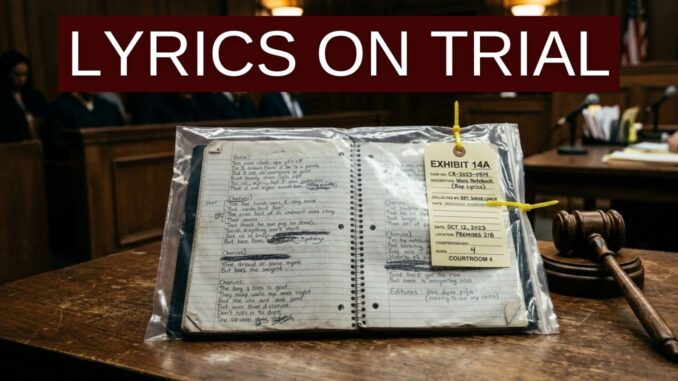
There is a question sitting before the United States Supreme Court right now that should matter to every person who has ever written a rap verse, performed one, or simply loved the genre enough to take it seriously. The question, stripped of its legal language, is “can the art you make be used to execute you?” In the case of James Broadnax, a Texas man convicted of a 2008 double murder in Garland, the answer from prosecutors has been yes. Broadnax is scheduled to be executed on April 30th. The basis for that sentence is not solely the crime he committed. It is, in significant part, forty pages of handwritten rap lyrics that a nearly all-white jury reviewed twice during deliberations before deciding he deserved to die. A coalition of artists, scholars, and legal advocates, including Killer Mike, T.I., Young Thug, Fat Joe, N.O.R.E., and Travis Scott, have filed briefs urging the Supreme Court to halt the execution and hear the case. They are asking the court to confront something the music industry and the legal system have been circling around for decades.
What Actually Happened in That Courtroom
Understanding the Broadnax case requires understanding how the Texas death penalty process works. A conviction alone is not enough to send someone to death row in Texas. Prosecutors must then convince the same jury, in a separate sentencing proceeding, that the defendant poses a continuing threat to society and is likely to commit more violent acts in the future. That is the standard. And in Broadnax’s case, the primary tool prosecutors used to meet that standard was not additional evidence of criminal history or expert testimony about behavior. It was rap lyrics he had written and never recorded, never performed, never published anywhere. Pages of creative writing, treated by the prosecution as a blueprint for future violence and presented to a jury that the judge himself acknowledged had been shaped by racially targeted jury selection. Prosecutors used peremptory strikes to remove all seven prospective Black jurors from the panel. The judge reinstated one, noted that the near-total absence of Black jurors concerned him quite a bit, and then proceeded anyway. That jury then decided Broadnax’s fate in part by reading his art.
The lyrics were not introduced during the guilt phase of the trial. They were held back specifically for the sentencing phase. That distinction matters enormously, and the legal brief filed by Texas attorney Chad Baruch points directly at it. If the lyrics were genuine evidence of criminal activity or intent, they should have been relevant at the guilt phase. Their absence there is effectively an acknowledgment by the state that the lyrics had no real evidentiary connection to the murders Broadnax committed. Their introduction at sentencing served a different purpose. They were there to make a jury afraid of him. And they worked.
Listen to Mr. Baruch discuss the brief the issue.
The Double Standard Is Not Subtle
Killer Mike, in an interview about the case, made an observation so simple and so precise that it bears repeating in full. Nobody believes that Johnny Cash actually shot a man in Reno just to watch him die. Nobody believes Neil Young shot his baby down by the river. Nobody believes Bob Marley shot the sheriff. These songs exist, their violent imagery is well documented, and their writers and performers have never been brought into a courtroom and asked to account for them as evidence of their character or their future dangerousness. The reason is obvious. Those artists are not Black. The genre they work in is not associated with Black urban culture. And the people who sit on juries and make decisions about their lives do not carry the same embedded biases toward them that they carry toward Hip Hop and the people who make it.
This is not a new argument. Researchers have been documenting the specific and measurable bias against rap music in legal settings for decades. One of the most frequently cited studies presented identical violent lyrics to two groups of participants, telling one group the lyrics were from a country song and the other group they were from a rap song. The group that believed they were reading rap lyrics consistently rated the content as more dangerous, more threatening, and more offensive. Same words. Different genre label. The difference in reaction was significant and has been replicated across multiple studies. Texas appellate attorney Baruch, who is lead counsel on the amicus brief in the Broadnax case, described this dynamic clearly: the danger of introducing lyrics into evidence is not just personal bias against the defendant. It activates racial anti-rap bias that prejudices the defendant on racial grounds simultaneously. You are not just putting the lyrics on trial. You are putting the culture and its association with Blackness on trial.
Seven Hundred Cases and Counting
The Broadnax case is not an outlier. It is the most extreme end of a practice that has been happening consistently since the late 1980s. Researchers at the University of Richmond have documented nearly 700 cases where rap lyrics were introduced as evidence in criminal proceedings. Those cases were overwhelmingly against Black and Latino defendants. The number is almost certainly an undercount. In almost every case, the person whose lyrics appeared in court was a defendant, rarely a witness or expert. The lyrics were introduced to show character, to establish future dangerousness, to persuade juries that the person writing them was telling the truth about themselves rather than doing what artists do, which is construct personas, explore dark themes, and use hyperbole as a creative tool.
The cases tell a consistent story. McKinley Phipps Jr., a rapper who performed as Mac, was convicted of murder in Louisiana in 2001 despite overwhelming evidence pointing elsewhere, including a confession from a venue security worker. His lyrics, particularly a song called “Murder, Murder, Kill, Kill,” were presented to the jury as evidence of his lifestyle. He spent two decades in prison. Vonte Skinner in New Jersey had notebooks of lyrics used against him at trial for attempted murder, lyrics the state conceded had been written long before the crime occurred. The New Jersey Supreme Court eventually ruled those lyrics should never have been admitted. Young Thug spent years fighting to keep his lyrics out of a racketeering case in Georgia before ultimately accepting a plea deal. Tay-K, convicted of murder in Texas, had his music video used by the jury in sentencing. The list runs long and in one consistent direction.
What almost none of these cases have is a parallel in other genres. No country songwriter has had their murder ballad introduced as evidence of their violent character. No heavy metal musician has faced prosecution in part because of what they wrote on an album. No actor has been sentenced based on the dialogue they performed in a film. The selective application of this standard to Hip Hop, and specifically to Black and Latino artists making Hip Hop, is not a coincidence or an oversight. It is a pattern.
What the Briefs Are Arguing
The brief filed on behalf of Killer Mike, T.I., Young Thug, Fat Joe, N.O.R.E., and dozens of other artists, scholars, and organizations makes several connected arguments that you may or may not agree with. The first is that gangster rap is a genre with established conventions, including depicting violence, criminal behavior, and extreme scenarios that anyone familiar with the form understands as creative constructions rather than autobiographical accounts. Tales of violence and criminal behavior are the grammar of the genre, the same way murder and betrayal are the grammar of Greek tragedy. Familiarity with the form is what allows you to understand the content. Judges and jurors with no context for Hip Hop cannot make that distinction reliably, and that unreliability has life and death consequences.
The brief filed by Travis Scott centers on the First Amendment. Using a person’s artistic expression to justify a death sentence violates free speech protections and basic principles of due process. If the threat of having your creative work used against you in a capital sentencing proceeding is real, the effect on artistic expression is direct and measurable. Artists will self-censor. They will avoid entire territories of creative exploration because the risk is too high. The chilling effect on one of the most vital and politically engaged art forms in American history would be significant.
Both briefs point toward something the legal system has been reluctant to fully confront. The admissibility standards that exist in federal and state evidence law are supposed to prevent juries from being unfairly prejudiced against defendants by evidence whose emotional impact outweighs its actual relevance. Rap lyrics, introduced in a death penalty proceeding, against a Black defendant, before a nearly all-white jury, in the absence of other evidence directly connecting the lyrics to the crimes, should fail that standard. In the Broadnax case, they did not.
The Culture Deserves Better from the Law
Hip Hop has always been, at its core, a form of testimony. It emerged from communities that had been systematically ignored and misrepresented, and it built a language to describe those experiences with precision and force. The violence in Hip Hop draws from a specific well. Even when it is exaggerated or imagined, the imagination is grounded in the documented reality of the environments that produced the genre. That context is what gives the content its weight and its meaning. A rapper who grew up surrounded by violence writes about violence differently than someone who has simply absorbed the content of the art form, and both are doing something fundamentally different from confessing to a crime. A jury without the cultural literacy to make those distinctions cannot make them. They are not reading art. They are being handed a weapon.
Killer Mike put it simply and correctly. It is still just art. It is an interpretation of the human spirit. It is not an admission of guilt. That should be obvious. The fact that it requires a Supreme Court filing to establish it as obvious, in a case where a man’s life is on the line, is a precise measurement of how far the legal system still has to go in its understanding of Hip Hop, of Blackness, and of the difference between expression and evidence. The artists who filed those briefs are not doing it for visibility. They are doing it because they understand, from experience and from proximity, that what happened to James Broadnax could happen to any of them. Could happen to anyone who ever picked up a pen and wrote something dark and honest and true, and had the misfortune of doing it in the one genre that courts have decided is not quite art.
The Supreme Court will rule on Broadnax’s request for a stay of execution before April 30th. Whatever the court decides, the underlying problem will not resolve itself with a single ruling. California passed legislation in 2022 requiring prosecutors to demonstrate that lyrics are directly relevant to a case and will not inject racial bias into proceedings before they can be admitted as evidence. New York has been working toward similar protections. The federal RAP Act, introduced in the House, would create a national standard limiting the admissibility of artistic expression as criminal evidence. These are the right directions. They are moving too slowly. And right now, in Texas, a man is waiting to find out if the words he wrote will be the last thing about him that matters.
James Broadnax is scheduled to be executed on April 30th in Huntsville, Texas.




Leave a Reply