
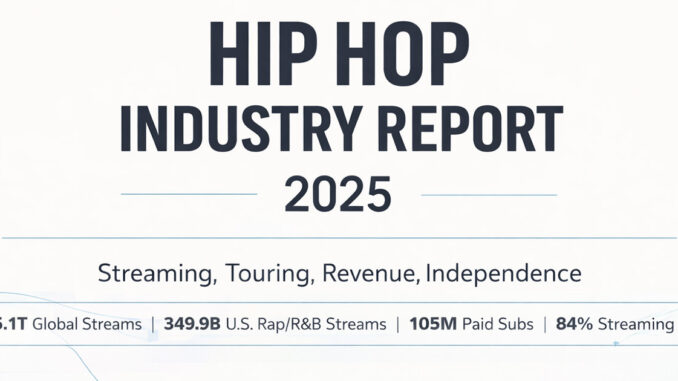
Hip hop did not “fall off” in 2025. It also did not get a free ride. The culture remained the dominant force in U.S. streaming by volume, but the marketplace kept shifting under everyone’s feet. Global streaming hit a new record. Catalog listening kept growing. New music fought harder for oxygen. Touring proved that rap can still compete at stadium scale, yet the live economy stayed top-heavy. And while streaming platforms highlighted massive payouts, the gap between the few who break through and the many who upload into the void got even clearer.
The most recent verifiable data on streaming, touring, and revenue, plus what it means for independent and mainstream hip hop
This article uses verifiable 2025 data that is available right now. New reports are expected around March 2026. That means year-end 2025 streaming totals and behavior signals from Luminate as reported by major press, 2025 touring numbers from Billboard Boxscore rollups, streaming platform transparency reports released in 2025, and the RIAA’s mid-year 2025 revenue report. It is not a vibes report. It is a map. If you are an artist, manager, producer, label, promoter, or brand operator inside hip hop, these are the signals you build strategy around.
1) Global streaming hit 5.1 trillion in 2025
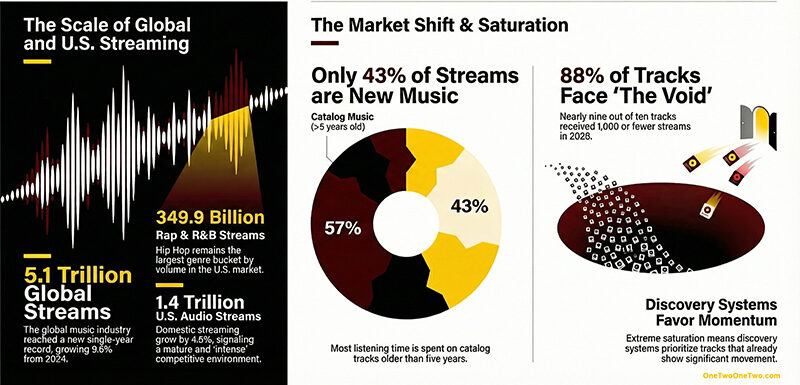
Luminate’s year-end reporting shows the global music industry reached 5.1 trillion streams in 2025, a new single-year record and up 9.6% from 2024. (AP News) That scale confirms streaming is still expanding worldwide, even if growth is no longer the explosive rocket ship it was earlier in the decade. The market is not shrinking. The market is intensifying. Every new release now lands in a system where listening is endless but attention is finite. That is the environment Hip Hop competes in daily.
For Hip Hop, global scale is not abstract. Rap is one of the most exportable modern genres, and the global audience is often reachable faster than the old radio-to-retail pipeline ever allowed. But bigger oceans mean bigger storms. If your plan is “drop and hope,” you are competing against the entire planet’s release schedule. The artists who win consistently in this environment build systems: release planning, content cadence, community loops, and catalog strategy.
2) The U.S. generated 1.4 trillion on-demand audio streams in 2025
The same Luminate year-end reporting shows the U.S. accounted for 1.4 trillion streams in 2025, up 4.6% year over year. (AP News) That matters for Hip Hip because the U.S. remains the genre’s most influential market in terms of narrative, playlist positioning, touring infrastructure, and brand spend. Growth is still positive, but it is slower than the global pace. That is what maturity looks like. It is not a collapse. It is a competitive plateau where gains come from retention and conversion, not simply “more people discovering streaming.”
For artists and labels, this changes the math of marketing. You can still break records, but you are less likely to do it by accident. You need a reason for the listener to return, not just to sample. You also need to think globally sooner, because the domestic streaming engine is no longer the only growth lever.
3) Rap and R&B led U.S. streaming with 349.9 billion streams
In the U.S., rap and R&B totaled 349.9 billion on-demand audio streams in 2025, the largest genre bucket by volume. (AP News) This is the kind of stat that should end the “is Hip Hop declining?” debate, at least in terms of consumption. Hip Hop is still the biggest streaming gravity in America. That gravity drives festival lineups, DSP priorities, brand interest, and media attention. It also means Hip Hop is the most crowded and competitive lane in the market.
Volume leadership is not a guarantee of individual artist income. It is proof the audience exists. The battle is for share of attention inside the biggest category on the board. That is why professional rollout strategy matters more now than it did when the algorithm felt easier to hack. The genre wins as a whole. Careers still rise and fall on execution.
4) The most important shift: only 43% of U.S. streams came from the last five years of music
Luminate reported that just 43% of U.S. on-demand streams in 2025 came from music released in the last five years (2021–2025). (AP News) In plain language, catalog listening outweighs new music listening. That is not a side note. It is the central structural change of the streaming era. It means the average listener is spending most of their time with older songs, not the newest drops. Hip Hop is now old enough to benefit from this, because the genre has multiple classic eras that new fans keep discovering.
For independent artists, this is both good news and a warning. The good news is that music can compound. A strong record can keep earning attention years later. The warning is that “new music only” strategies are fragile. If your entire business depends on every new release outperforming the previous one, you are running uphill forever. Catalog strategy is not nostalgia marketing. It is revenue strategy.
5) Oversupply is real: 88% of tracks got 1,000 or fewer streams in 2025
Luminate’s year-end findings also point to extreme saturation: 88% of tracks received 1,000 or fewer streams in 2025, as summarized in reporting about the year-end data. (DJ Mag) The exact implication is brutal. Most releases never reach meaningful consumption. This is not a statement about talent. It is a statement about market structure. There is more music than the audience can possibly process, and discovery systems favor what is already moving.
For Hip Hop, saturation cuts two ways. It means the floor is accessible. Anyone can upload. It also means the ceiling requires differentiation and momentum. The artists who treat marketing like part of the art, and who build repeatable attention engines, have a massive advantage. The ones who release into silence and move on are feeding the statistics.
6) Touring stayed blockbuster at the top: Kendrick Lamar & SZA grossed $358.7M
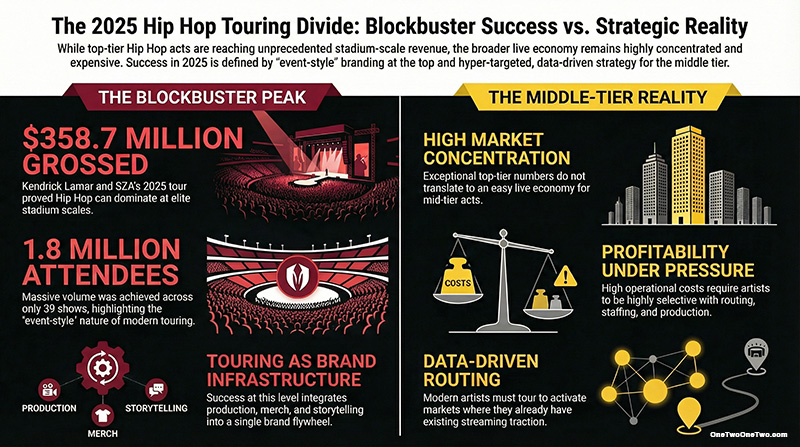
Billboard’s Top Tours list shows Kendrick Lamar & SZA at $358.7 million gross, 1.8 million attendance, across 39 shows on the year’s top tour ranking. (Billboard) That is an important Hip Hop signal because it proves rap is not confined to clubs and arenas. At the highest tier, Hip Hop can sell stadium-scale experiences at elite revenue levels. It also proves the modern touring winner is often an event, not just a concert. The production, the branding, the pacing, the merch ecosystem, and the storytelling all matter.
For independent and mid-tier rap, the lesson is not “go do stadiums.” The lesson is to think like a product builder. Your show needs identity. Your tour needs narrative. Your live video content needs a plan. Touring is increasingly a brand flywheel that boosts streaming, merch, and long-term fan loyalty.
7) Touring is still concentrated: one hot tour does not mean the live economy is easy
Here is what people forget when they cite big tour numbers. The top of the market is thriving, but the costs of touring have been high in recent years, and the middle tier often has to fight for profitability through routing, staffing, and production choices. Billboard’s Boxscore coverage regularly emphasizes reported figures and record-breaking runs, but it also reveals how few acts are operating at that scale. (Billboard)
For Hip Hop, the strategic takeaway is to avoid “touring because you’re supposed to.” Tour with a goal. Tour to activate markets where you already have streaming traction. Tour to sell merch and deepen community. Tour to collect content. If you cannot make the math work, do targeted runs and stack them with media, collabs, and fan events instead of burning money chasing optics.
8) U.S. recorded music revenue in 2025: what we can verify right now is mid-year
The RIAA’s mid-year 2025 report shows U.S. recorded music revenues across all formats hit $5.6 billion in the first half of 2025. (RIAA) Streaming generated $4.68 billion, accounting for 84% of the market in that mid-year window. (RIAA) Paid subscription revenues grew to $3.2 billion, with subscription accounts rising 6.4% year over year to 105 million. (RIAA)
This is the most recent audited U.S. revenue picture that is fully published for 2025 at the time of writing. It confirms what everyone already lives: streaming is not a side income stream. It is the business. And when roughly four out of five dollars flow through streaming, the platform economy shapes how labels sign, how artists release, and how discovery systems are engineered. For Hip Hop, this is why metadata accuracy, split clarity, and publishing administration are not “back office” details. They are direct revenue levers.
9) Vinyl stayed meaningful in 2025, even in a streaming-dominant world
RIAA’s mid-year 2025 reporting shows vinyl held steady at $457 million, making up more than three-quarters of physical music revenues. (RIAA) Vinyl shipments exceeded CDs for the fifth consecutive year. (RIAA) This is not a Hip Hop-only story, but it is relevant to the culture because Hip Hop has always valued artifacts: limited drops, collector energy, and tangible identity objects. Physical product is not the core market anymore, but it can be a high-margin lane for artists with real fandom.
For independent Hip Hop, physical can be a strategic weapon. It forces you to think about design, scarcity, and community. It also encourages direct-to-fan infrastructure like email lists, Shopify stores, and fulfillment partners. If your audience is real, physical gives you a way to monetize without waiting on fractional streaming pennies and royalty cycles.
10) Spotify’s transparency reports (released in 2025) show enormous payouts, but uneven outcomes
Spotify’s Loud & Clear reporting released in 2025 states Spotify paid the music industry over $10 billion in 2024, described as its largest annual payout at the time. (Loud and Clear) Spotify also reported that nearly 1,500 artists generated over $1 million in royalties on Spotify in that year. (Reuters) The point for Hip Hop in 2025 is not to argue the exact per-stream math. The point is to understand how modern income is structured. Streaming at scale creates huge payouts. Those payouts go to rights holders, then flow to artists based on deals and splits.
For independent artists, this is where ownership becomes a strategy, not a slogan. If you control masters and publishing, you keep a larger share of what your music generates. If you do not, your success may still generate headlines while your take-home stays thin. Transparency reports do not solve the payout debate. They do provide a clearer look at how rare meaningful earnings are without real scale.
11) YouTube reported paying over $8 billion to the music industry in a 12-month window ending in 2025
YouTube announced that between July 2024 and June 2025, it paid out over $8 billion to the music industry. (blog.youtube) Hip Hop should pay attention because the culture is inherently visual, and YouTube remains one of the most powerful discovery engines in the world. Music videos are not just marketing assets. They are income sources. Shorts-era consumption also means that clips, live sessions, behind-the-scenes moments, and performance footage can all drive discovery and revenue.
For independent rap, YouTube can be a practical equalizer if you treat it like a channel, not an afterthought. Upload strategy, thumbnail identity, titles, and consistent formats matter. The artists who build visual series, not just occasional videos, tend to perform better over time. And if catalog listening is winning, YouTube catalog content can keep earning for years.
12) The “new music problem” is real, and Hip Hop has to adjust release thinking
When only 43% of U.S. streams come from recent music, the newest releases are fighting the entire history of recorded music for attention. (AP News) Hip Hop is especially affected because the release volume in rap is massive and the audience is constantly offered new options. In this environment, dropping more music can help, but only if the drops are connected to a system that builds repeat listening. If every single is a new identity, fans cannot attach. If your visuals are inconsistent, the algorithm does not know how to route you. If you do not reactivate older records, you waste your own catalog.
The strategic response is not “release less.” It is “release smarter.” Tie releases to narrative arcs. Keep sonic identity coherent enough to build recognition. Use collaborations strategically. And build a back catalog that new fans can binge. Catalog is not only the past. It is the engine that monetizes your future audience.
13) Independent Hip Hop is structurally positioned for this era, if it operates professionally
The 2025 landscape rewards operators who can move fast, own assets, and build direct relationships. That is an independent advantage. You can release on your schedule, test content formats quickly, and keep ownership clean. But independence only pays when the business is real. You need rights clarity. You need clean metadata. You need publishing administration. You need a system for email and SMS. You need merch and ticketing infrastructure. The RIAA and Luminate numbers explain why. Streaming is the dominant revenue channel, catalog is most of consumption, and saturation is extreme. (RIAA)
In other words, the independent advantage is not “no label.” It is “no permission.” The artists winning independently in 2025 are the ones building companies around themselves, even if they are small companies. They collect data. They convert listeners to subscribers. They sell to superfans. They build content engines. They treat tours like products. They run their catalog like a portfolio.
14) A note on what is missing: full year-end 2025 revenue totals are not all published yet
Because it is 2026, a lot of 2025 data is available. But not everything you might want for a definitive “2025 by the dollars” breakdown has been released in final form everywhere. For the U.S., the RIAA has published mid-year 2025 revenue totals, which are authoritative for the first half of the year. (RIAA) For global industry-wide year-end totals, some “full-year 2025” revenue reporting may still be in the pipeline depending on the publishing calendar of each organization. That is why this article focuses on the most recent, clearly attributable 2025 datasets that are already public: Luminate year-end streaming behavior, Billboard’s 2025 touring rankings, major platform transparency reports released in 2025, and RIAA mid-year 2025 revenues.
This is not a loophole. It is good journalism. If a number is not published in a primary source, we do not invent it. We build insight from what is verified, and we update totals when audited year-end reports become available.
15) The bottom line for Hip Hop in 2025
Hip Hop remained the biggest streaming force in the U.S. by volume, with rap and R&B at 349.9 billion streams. (AP News) Global streaming hit 5.1 trillion, confirming the market is still expanding. (AP News) At the same time, catalog dominated listening, with only 43% of U.S. streams coming from the last five years of releases. (AP News) Touring proved rap can still sell at elite scale, highlighted by Kendrick Lamar and SZA’s $358.7 million run on Billboard’s Top Tours list. (Billboard) And the business economics remained streaming-led, with RIAA mid-year 2025 showing streaming at 84% of recorded revenue and paid subscription accounts at 105 million. (RIAA)
If you are building in Hip Hop, the strategy is no longer just to chase the moment. The strategy is to compound. Build catalog. Build superfans. Build a live experience worth buying. Build a visual identity that drives discovery. Build ownership and admin systems so the money you generate actually reaches you.
Hip Hop is still the culture’s loudest language. In 2025, it was also a lesson in modern business reality: scale is huge, but structure is everything.
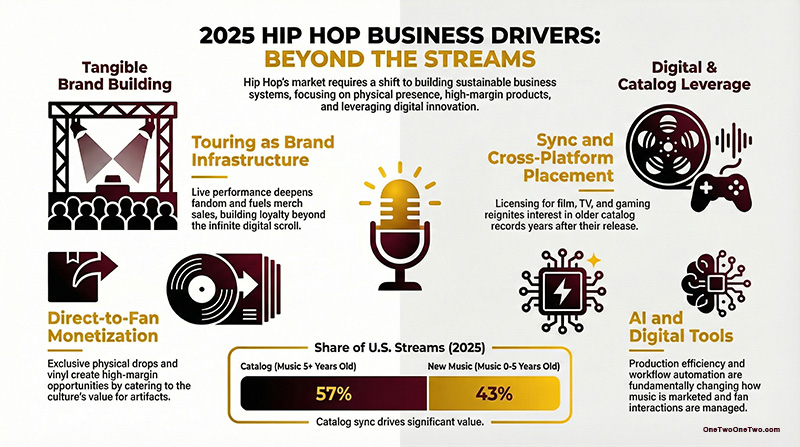
The 2025 Business Drivers in Hip Hop
Now let’s step beyond the stats and talk about where the real money and leverage sit.
Touring as Brand Infrastructure
Touring builds audience retention. It drives merch. It fuels social content. It increases catalog streaming in cities visited.
The data shows top tours generating hundreds of millions. But the real insight is that live performance deepens fandom. In an attention economy dominated by infinite scroll, physical presence builds loyalty.
Sync and Cross-Platform Placement
As catalog consumption rises, sync licensing becomes more valuable. Film, television, gaming, and short-form content rely heavily on recognizable records.
Older Hip Hop tracks are seeing renewed life through placements. A sync placement can reignite a catalog record years after release.
Direct-to-Fan Monetization
Vinyl’s multi-year growth streak may be plateauing according to Recording Industry Association of America data. Physical formats are niche but can be profitable.
Direct-to-fan sales through vinyl, deluxe drops, and exclusive merch create higher margin opportunities.
Hip Hop culture values tangible artifacts. That cultural instinct aligns with business opportunity.
AI and Digital Tools
AI is already influencing chart ecosystems, production tools, and fan interaction. Luminate reporting has acknowledged the presence of AI-generated acts in measurable music ecosystems.
Hip Hop’s relationship with authenticity means AI adoption will be complex. But production efficiency, content creation tools, and workflow automation are already impacting how music is made and marketed.
Final Takeaway
The industry is larger than ever. Streaming is dominant. Catalog outperforms novelty. Touring is premium. Platforms are paying billions. Independence is viable.
Hip Hop sits at the center of this ecosystem. But dominance does not guarantee success. Strategy does.
If you are building in 2026, think long term. Think catalog. Think ownership. Think systems.
The culture is still out here. The business is bigger than ever.




Leave a Reply